Promote your playschool effectively is crucial for attracting new families, building trust, and ensuring steady admissions. With increasing competition in early education, a smart, multi-channel approach can make all the difference. This guide shares proven strategies, creative ideas, and actionable tips to help you market your playschool and stand out in your community.
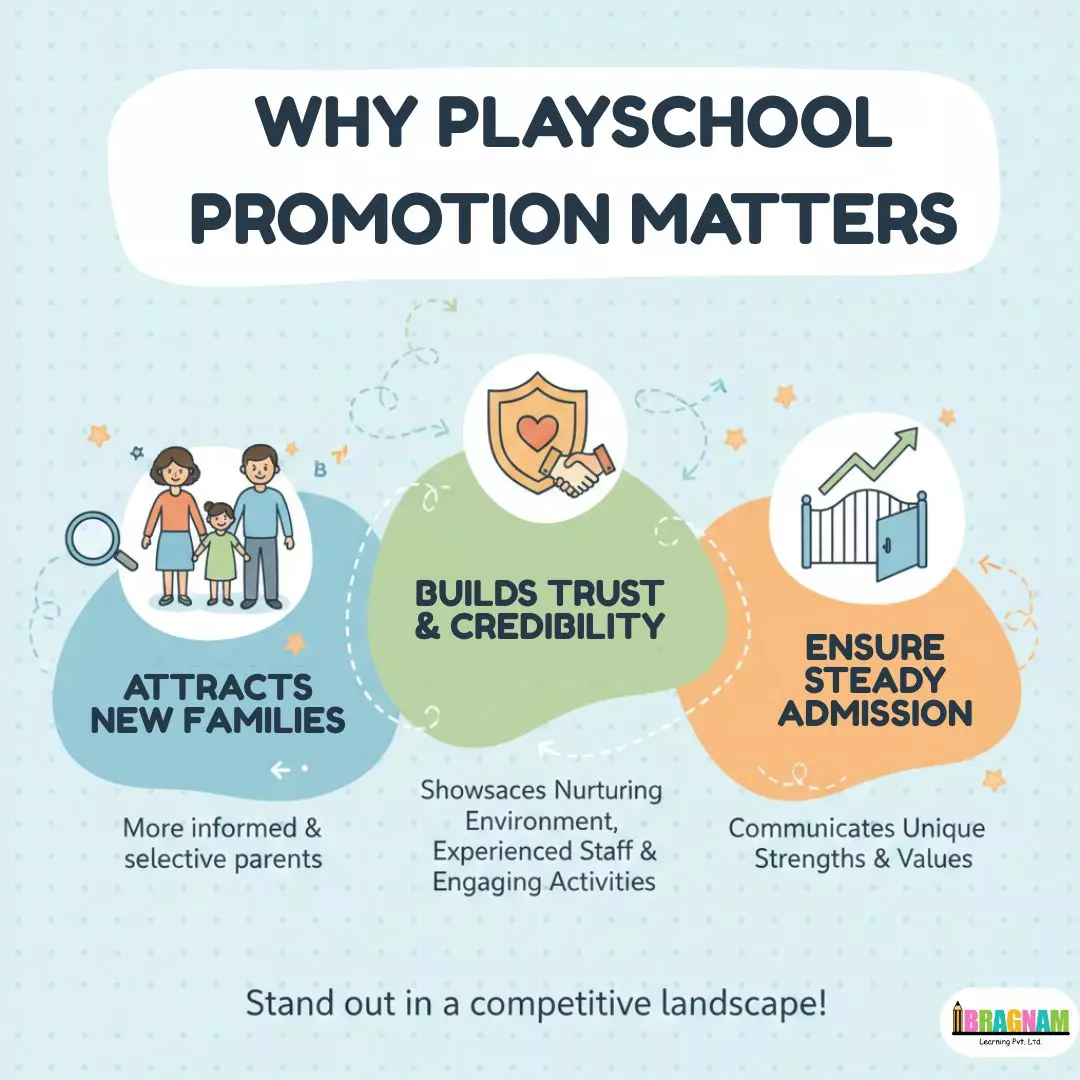
Why Playschool Promotion Matters
Parents today are more informed and selective than ever. They look for schools that offer not just education, but a nurturing environment, experienced staff, and engaging activities. A strong promotion plan helps communicate your playschool’s unique strengths and values, making it easier for parents to choose you over others.
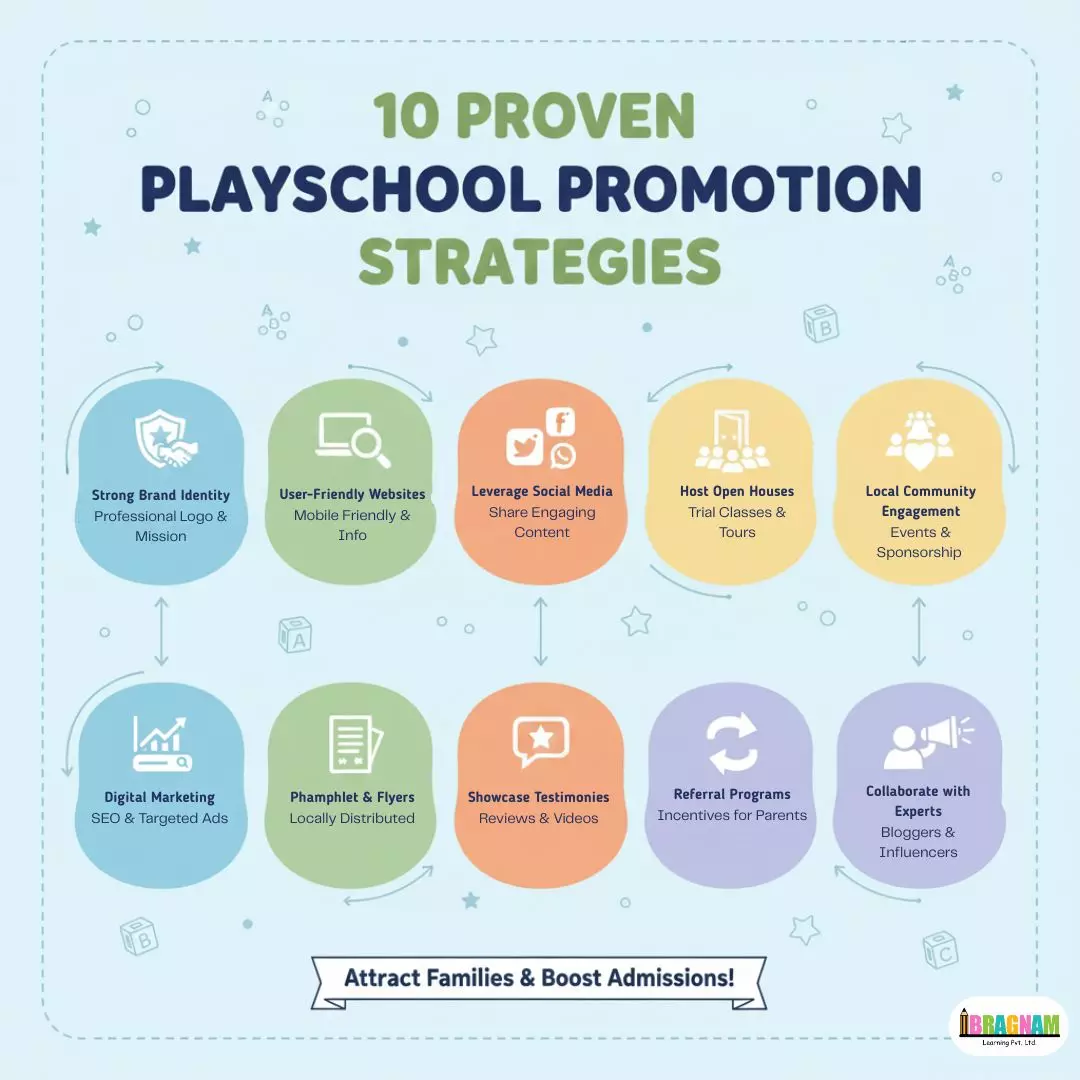
10 Proven Playschool Promotion Strategies
1. Build a Strong Brand Identity
A memorable brand helps parents instantly recognize your playschool. Invest in a professional logo, consistent color scheme, and a clear mission statement. Make sure your branding is visible on all marketing materials, from pamphlets to your website.
2. Create a User-Friendly Website
Your website is often the first point of contact for parents. Ensure it is mobile-friendly, easy to navigate, and includes information about your curriculum, staff, facilities, and contact details. Add a photo gallery and testimonials for authenticity.
3. Leverage Social Media
Social media platforms like Facebook, Instagram, and WhatsApp are powerful tools for reaching parents. Share engaging content—photos, videos, event updates, and parenting tips. Run contests and encourage parents to share their experiences.
4. Host Open Houses and Demo Classes
Invite parents and children to experience your playschool firsthand. Open houses, trial classes, and fun activity sessions allow families to see your environment, meet teachers, and learn about your curriculum.
5. Engage with the Local Community
Participate in local events, sponsor community activities, and collaborate with nearby schools or businesses. This builds trust and increases your visibility.
6. Use Digital Marketing
Invest in Google Ads, local SEO, and targeted social media ads. Create landing pages for admissions and use email newsletters to keep parents informed about your latest programs and events.
7. Distribute Pamphlets and Flyers
Hand out informative pamphlets and flyers at local markets, parks, and community centers. Make sure they highlight your unique selling points and include a clear call-to-action.
8. Collect and Showcase Testimonials
Happy parents are your best advocates. Ask for reviews and testimonials, and feature them on your website and social media. Video testimonials are especially effective.
9. Run Referral Programs
Encourage current parents to refer friends and family by offering incentives such as discounts or free admission days. Word-of-mouth is one of the most powerful marketing tools.
10. Collaborate with Influencers and Experts
Partner with parenting bloggers, local influencers, or education experts to promote your playschool. Their endorsement can boost your credibility and reach.
Creative Playschool Marketing Ideas
Organize themed playgroups (arts & crafts, storytelling, science exploration).
Host fun events like carnivals, storytelling sessions, or parent-child workshops.
Create informative video content showing a “day in the life” at your playschool.
Sponsor local sports teams or family festivals to increase visibility.
Offer free parenting workshops or seminars on early childhood development.
Maximizing Parent Engagement
Respond promptly to inquiries on social media and your website.
Share regular updates about classroom activities, upcoming events, and parenting tips.
Create a WhatsApp group for parents to foster a sense of community.
Frequently Asked Questions (FAQs)
Q1: What are the best ways to attract parents to my playschool? A: Focus on building a strong online presence, hosting open houses, sharing testimonials, and engaging with the local community.
Q2: How can I promote my playschool on a budget? A: Use social media, distribute flyers, run referral programs, and participate in local events—all cost-effective ways to boost visibility.
Q3: Why is branding important for a playschool? A: A strong brand helps parents recognize and trust your playschool, making it easier for them to choose you over competitors.
Q4: How do I use digital marketing for my playschool? A: Invest in local SEO, run targeted ads, create a user-friendly website, and use email newsletters to stay connected with parents.
Q5: What kind of events can I organize to promote my playschool? A: Host open houses, demo classes, carnivals, storytelling sessions, and parenting workshops to attract families and build community connections.
By trrijesh|2025-12-08T11:12:57+05:308 December 2025|Blog|
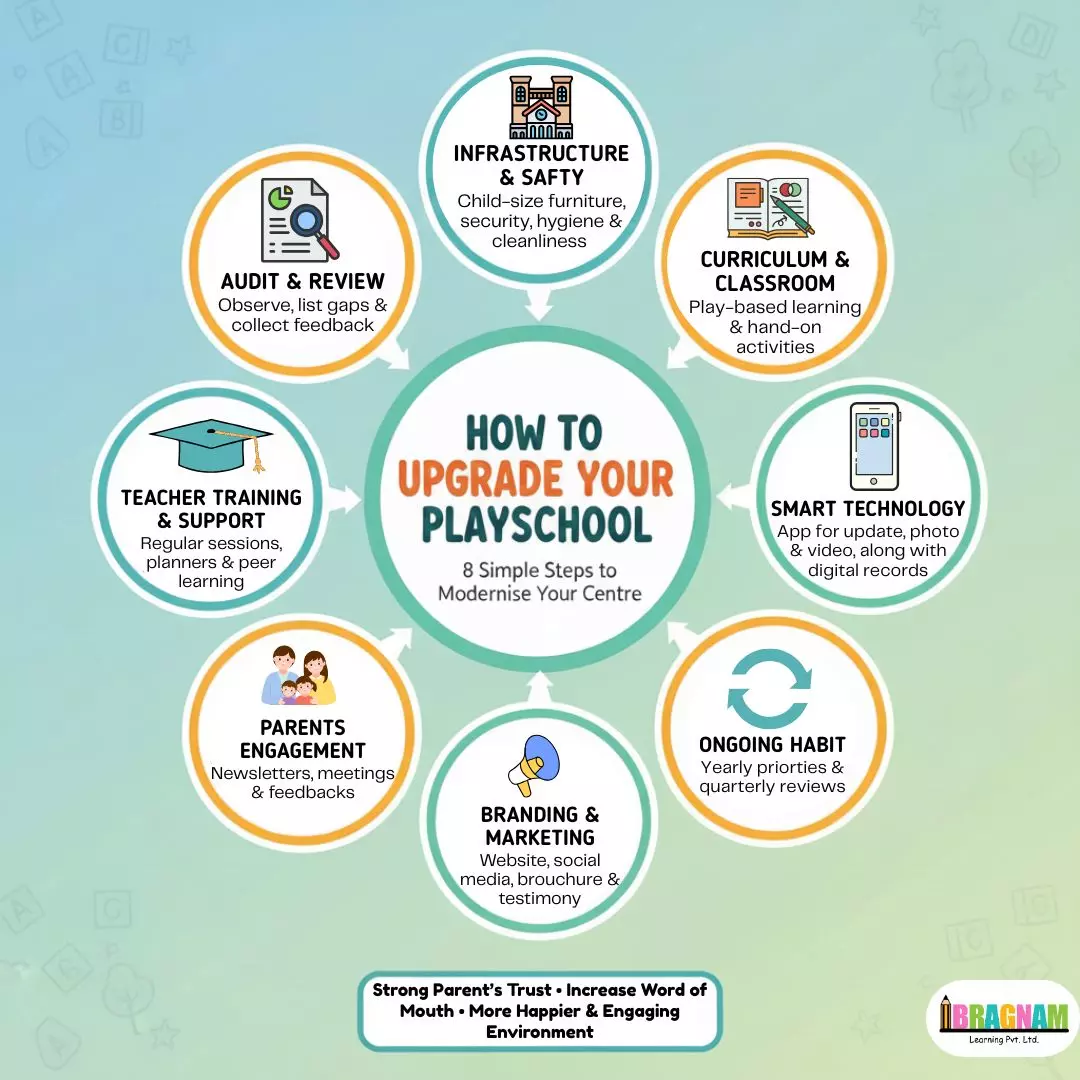
Upgrading your playschool is about much more than adding a few new toys or painting the walls a brighter colour. It means reimagining your space, systems, and teaching so that children learn better, parents feel confident, and your team enjoys coming to work every day.
When you focus on how to upgrade your playschool in a planned way, you can improve learning outcomes, increase admissions, and build a strong reputation in your community. Simple, step-by-step changes in infrastructure, curriculum, teacher training, and parent communication can transform your centre without wasting money or confusing your staff.
Why upgrading your playschool matters
Parents today are more aware, research-focused, and selective when choosing a playschool. They look at safety, cleanliness, teaching methods, communication, and overall experience before making a decision. Upgrading your playschool helps you match these expectations and stand out in a competitive market.
A well-upgraded playschool:
Builds stronger trust with families
Increases word-of-mouth admissions
Creates a happier, more engaging environment for children and staff
Step 1: Audit before you upgrade your playschool
The first step in how to upgrade your playschool is to honestly review where you are today. Before buying anything new, spend time observing, listing gaps, and collecting feedback from parents, teachers, and support staff.
You can create a simple audit checklist with points like:
Classroom layout and space usage
Safety, cleanliness, and hygiene
Learning corners and teaching materials
Outdoor play and gross motor activities
Parent communication and satisfaction
Once you finish this audit, you will know exactly how to upgrade your playschool in a focused way, instead of making random, disconnected changes.
Step 2: Upgrade infrastructure and safety
A huge part of how to upgrade your playschool is improving the physical environment and safety standards. Parents notice lighting, ventilation, toilets, flooring, and entry–exit security from the very first visit. Basic early childhood guidelines stress age-appropriate furniture, safe play spaces, and hygiene facilities.
Think about upgrading:
Classrooms: Child-sized tables and chairs, open shelves at child height, soft floor rugs, and clear walking paths
Toilets and wash areas: Low basins, liquid soap, tissue or towels, clean dustbins, and non-slippery tiles
Safety: Fire extinguishers, visible exit plans, covered electrical points, CCTV (with clear privacy rules), and safe outdoor equipment
Cleanliness: Daily cleaning schedule, sanitisation routines, and organised storage for toys and learning aids
These changes make your centre safer and more comfortable, and they directly support your promise to parents when you talk about how to upgrade your playschool.
Step 3: Upgrade your curriculum and classroom experience
How to upgrade your playschool also means upgrading what children actually do every day. A strong early years programme is play-based, child-centred, and aligned with age-appropriate learning outcomes like language, numeracy, motor skills, and social–emotional development.
To upgrade your curriculum, you can:
Use monthly or weekly themes (seasons, community helpers, animals, transport, festivals) to organise activities and keep learning engaging
Blend free play, circle time, storytelling, art, music, movement, and simple experiments into each day
Add hands-on materials such as puzzles, blocks, sorting trays, pretend-play corners, and fine-motor activities
This keeps your promise in the title “How to upgrade your playschool” by making learning richer, more joyful, and more meaningful for children.
Create learning corners when you upgrade your playschool
Learning corners are a simple, powerful way to upgrade classrooms:
Literacy corner: Picture books, alphabet cards, puppets, and story mats
Numeracy corner: Counting objects, shape sorters, number puzzles, and patterning games
Sensory corner: Sand trays, water play (supervised), textured materials, and simple science activities
Art corner: Crayons, paper, child-safe scissors, glue, and collage materials
Clearly labelled corners help children move, choose, and explore on their own, which is an essential part of early childhood development.
Step 4: Invest in teacher training and support
No plan on how to upgrade your playschool is complete without investing in your teachers. Even the best curriculum and materials will not work if teachers are not trained, supported, and motivated.
You can upgrade your playschool by:
Organising regular training sessions on classroom management, play-based teaching, observation, and documentation
Sharing simple lesson plan templates, activity banks, and monthly planning formats
Encouraging teachers to reflect, share ideas, and visit each other’s classes for inspiration
When teachers feel confident and supported, they deliver more engaging activities, communicate better with parents, and naturally become ambassadors for your upgraded playschool.
Step 5: Use technology smartly when you upgrade your playschool
Modern parents appreciate playschools that use technology wisely to communicate, record learning, and manage operations. The secret of how to upgrade your playschool with technology is to keep it child-safe, age-appropriate, and helpful for adults, not screen-heavy for children.
Smart ways to use technology include:
A simple app or portal for attendance, announcements, and fee reminders
Sharing photos and short videos of classroom activities with parental consent
Digital records for progress reports and portfolio-style documentation
Occasional use of audio stories, rhymes, or interactive whiteboards to support lessons
This kind of thoughtful technology upgrade supports transparency, builds trust, and shows parents that your playschool is modern yet child-focused.
Step 6: Strengthen parent engagement when you upgrade your playschool
How to upgrade your playschool also includes upgrading your relationship with families. Parents want to feel informed, included, and heard.
Simple, consistent parent engagement ideas:
Monthly newsletters or WhatsApp updates summarising learning themes, events, and reminders
Parent–teacher meetings that focus on the child’s strengths and practical suggestions, not just problems
Open days, class presentations, and celebrations where parents can see their child in action
Feedback forms or quick digital surveys after events and at the end of each term
Upgraded communication builds a strong playschool community and makes parents more likely to recommend your centre to others.
Step 7: Refresh branding, marketing, and admissions
If you are thinking about how to upgrade your playschool, also think about how your brand looks and sounds to the outside world. Many centres upgrade internally but forget to update their marketing, which means parents do not notice the improvements.
You can:
Update your website and social media pages with new photos, videos, and clear information about your upgraded features
Rewrite your brochure, Google My Business listing, and online profiles to highlight safety, curriculum, activities, and parent engagement
Collect and showcase genuine testimonials and success stories from satisfied parents
These steps ensure that when people search for playschools in your area, your upgraded centre makes a strong, professional impression.
Step 8: Make upgrading your playschool an ongoing habit
How to upgrade your playschool should not be a one-time project. The best centres build small, regular improvements into their yearly plan so they keep growing and adapting.
You can:
Set yearly priorities (for example: “This year we will focus on outdoor play and teacher training”)
Review progress every quarter with your team
Keep a running list of ideas, parent suggestions, and teacher requests for future upgrades
This mindset helps your playschool stay fresh, innovative, and responsive to children’s and parents’ needs.
FAQs about how to upgrade your playschool
How do I start if I have a limited budget to upgrade my playschool? Begin with low-cost, high-impact changes like decluttering classrooms, rearranging furniture, creating learning corners, and improving cleanliness and communication. Focus first on safety and daily classroom experience before investing in big décor or equipment.
What is the most important area to focus on when upgrading a playschool? Safety and classroom quality should always come first. Once basic safety, hygiene, and child-friendly furniture are in place, you can upgrade curriculum, teacher training, and parent engagement step by step.
How can I show parents that I have upgraded my playschool? Share before–after photos, highlight new features in your admission counselling, update your website and social media, and communicate clearly during parent meetings and open house events. Encourage existing parents to share their experience with other families.
How often should I review how to upgrade my playschool? A simple internal review once a year is a good routine, with smaller check-ins every term. This helps you catch gaps early and plan upgrades during holidays or low-enrolment periods.
Can technology really help upgrade my playschool? Yes, when used wisely. Technology can improve communication, record-keeping, and transparency without replacing play-based learning. Use it mainly for parent updates, documentation, and basic admin tasks rather than heavy screen time for children.
Conclusion: Take the next step to upgrade your playschool
How to upgrade your playschool becomes easy and manageable when you break it into clear steps: audit your current setup, improve safety and infrastructure, refresh curriculum, support teachers, add smart technology, and deepen parent engagement. Each small improvement builds a better experience for children and a stronger brand for your centre.
If you are serious about how to upgrade your playschool, start today with one simple change—rearrange a classroom, plan a new theme, schedule a teacher training, or send a more thoughtful update to parents. These actions will move you closer to the upgraded, high-quality playschool you imagine.
By amit|2025-12-04T16:40:45+05:304 December 2025|Blog|
When temperatures drop, many parents worry that children will be “stuck” indoors and glued to screens, but winter can actually be one of the most playful, imaginative seasons of the year. With the right winter wonderland fun activities for kids, you can create routines that boost immunity, build resilience, and keep little ones learning through play.
Winter-themed games, crafts, and outdoor experiences help children strengthen their muscles, practice problem-solving, and develop social skills as they play with siblings and friends. The key is offering a mix of indoor and outdoor options so families can choose what works best for the weather and their child’s energy level each day.
Benefits of Winter Play for Kids
Cold-weather activities are about much more than “passing time”; they play a real role in holistic child development.
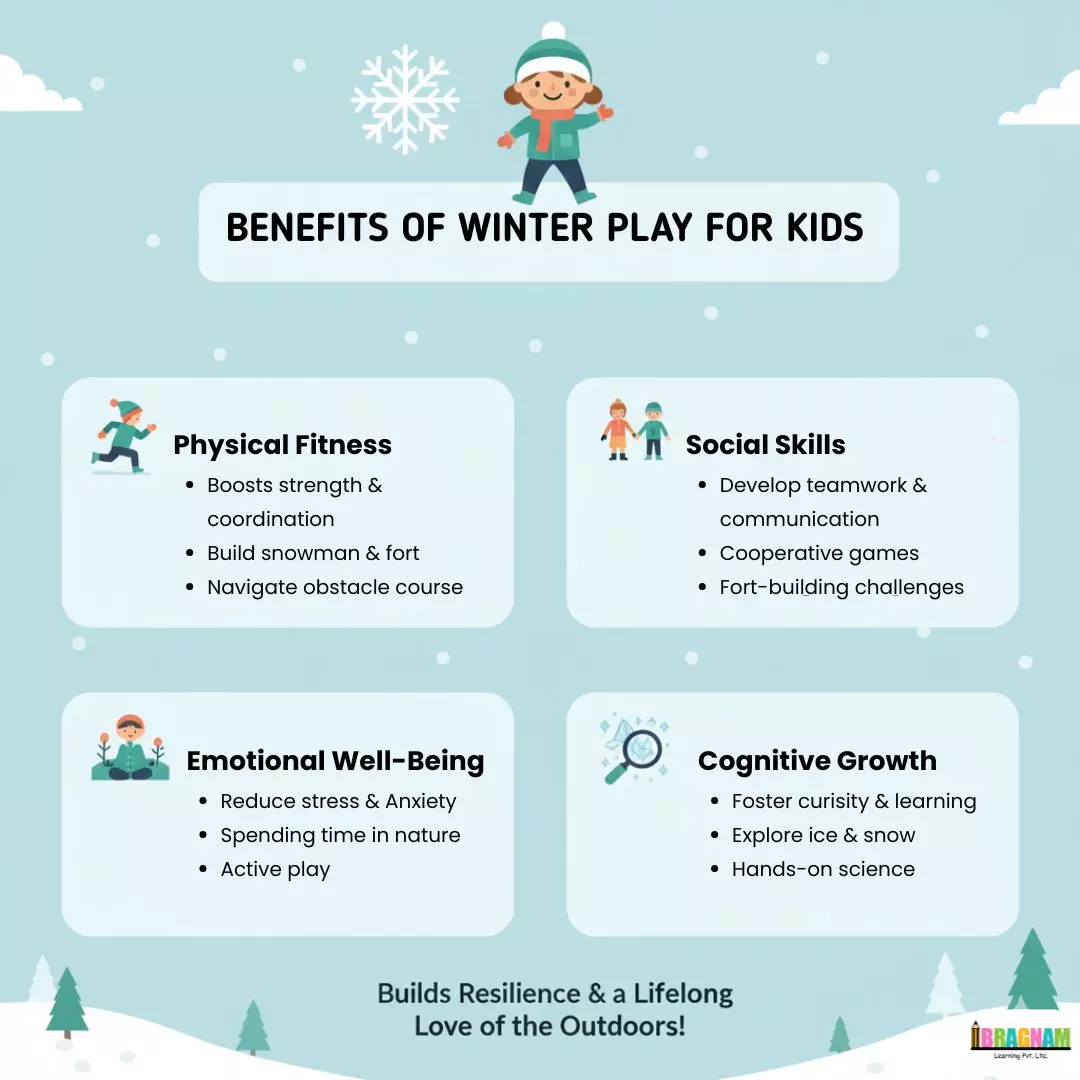
Physical fitness: Building snowmen, running through parks, or navigating indoor obstacle courses all improve strength, coordination, and balance.
Emotional well-being: Time in nature and active play reduce stress and anxiety, helping children regulate big feelings more effectively.
Social skills: Cooperative games, fort-building, and team challenges encourage communication, turn-taking, and problem-solving with peers
Cognitive growth: Exploring ice, snow, and seasonal changes gives children hands-on science experiences that build curiosity and critical thinking.
Embracing winter as a season of exploration rather than something to “get through” helps children build resilience and a lifelong love of the outdoors.
Outdoor Winter Wonderland Fun
When the weather is safe, stepping outside can transform an ordinary day into a magical winter wonderland for kids.
Simple Snowy Adventures
Even a small outdoor space can host plenty of winter play ideas.
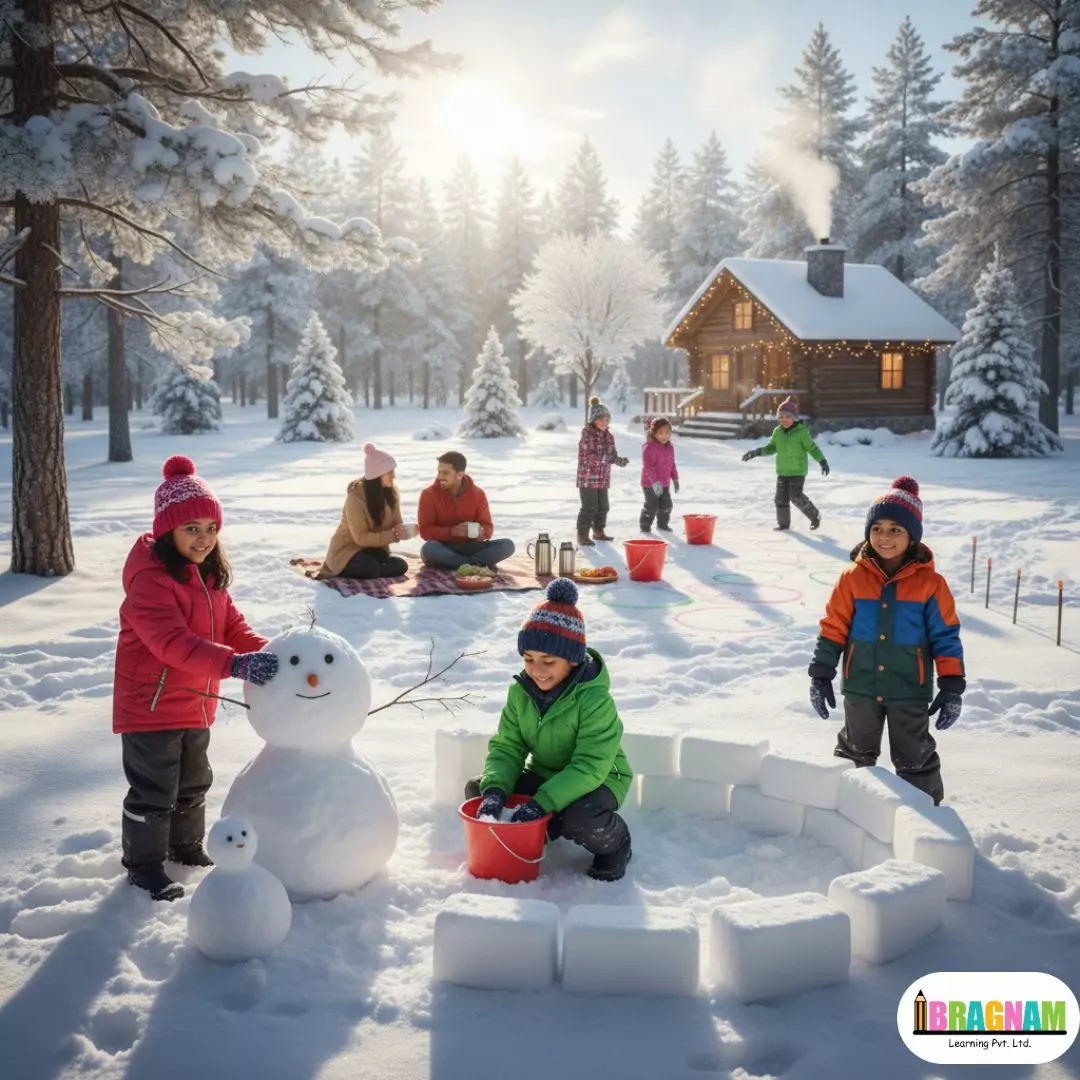
Build a snow family: Invite children to roll different-sized snowballs, stack them, and decorate with natural materials like twigs and pinecones.
Snow fort or castle building (with safety rules): Use buckets or plastic containers to pack “snow bricks” and create low, open structures for imaginative play.
Winter nature walk: Go for a slow walk to look for animal tracks, frost patterns, and winter birds, encouraging children to describe what they see, hear, and feel.
Sunlit winter picnic: On milder days, spread a blanket in a park, sip warm soup or cocoa, and let kids run and play between bites.
These activities keep children moving, which supports cardiovascular health while also feeding their sense of wonder.
Movement Games in the Snow
Structured games can make winter exercise feel like an adventure.
Snow target toss: Shape soft snowballs and aim them at targets like buckets or chalk circles on the ground, focusing on accuracy, not hitting people.
Follow-the-leader tracks: One child leads while others step into their footprints, practicing balance and coordination on snow or frost.
Winter obstacle trail: Use cones, sticks, or natural landmarks to create a path where kids jump, hop, tiptoe, and crawl through the snow.
Games like these improve gross motor skills and body awareness, often without children realizing how much exercise they are getting.
Indoor Winter Wonderland Activities
On very cold, wet, or polluted days, indoor winter wonderland fun activities for kids keep them upbeat and engaged without needing to step outside.
Cozy Crafts and Creative Play
Winter crafts double as quiet-time activities and fine-motor workouts.
Snowflake art: Children can cut simple paper shapes (with support) and decorate with crayons, cotton, or glitter to explore symmetry and patterns.
Winter sensory bins: Fill tubs with cotton balls, rice, or pasta and add scoops, toy animals, and “ice cubes” for scooping, pouring, and imaginative stories.
DIY winter storybooks: Encourage children to draw a snow-day adventure and dictate the story while an adult writes their words, blending literacy with creativity.
These activities support creativity, hand–eye coordination, and early language skills in a calm, enjoyable way.
Indoor Movement and Gross Motor Fun
Even inside, children need chances to stretch, jump, and use their big muscles.
Indoor obstacle course: Arrange cushions, chairs, tunnels made from blankets, and taped “balancing lines” to create a safe challenge path.
Dance party in the “snow”: Play winter songs and let children dance with scarves or ribbons, pretending they are snowflakes swirling in the wind.
Yoga and stretching: Simple animal poses, “ice skater” lunges, and breathing exercises help children strengthen their bodies and calm their minds.
Indoor movement not only burns energy but also improves focus and mood for the rest of the day.
Safety Tips for Winter Play
To keep winter wonderland fun activities for kids safe, a few simple guidelines go a long way.
Dress in layers: Start with moisture-wicking clothing, add warm layers, and top with a waterproof jacket, mittens, and boots.
Protect “cold zones”: Ensure ears, nose, fingers, and toes are covered because these areas are more prone to frostbite.
Set time limits: Plan regular warm-up breaks indoors to prevent hypothermia and overexposure to cold.
Choose safe play areas: Keep children away from roads, snowbanks, and snowplows; opt for clear, open spaces instead.
Hydrate and fuel: Offer water and healthy snacks because children burn energy faster in cold temperatures.
Following these precautions allows families to enjoy the magic of winter while minimizing risk.
Winter Wonderland Ideas for Preschools and Playschools
Early years settings can turn their campuses into seasonal learning labs with a few thoughtful setups.
Winter-themed learning centers: Set up corners for sensory play, art, pretend “winter café,” and science exploration with ice and water.
Group outdoor sessions: Short, supervised outdoor playtimes with clear rules for clothing and safety help children build healthy cold-weather habits.
Integrated curriculum: Link winter stories, songs, counting games, and craft projects so children meet academic goals through seasonal play.
Communicating these ideas with parents encourages them to continue similar activities at home, strengthening home–school partnerships.
Conclusion: Make Winter Your Child’s Favorite Season
Winter wonderland fun activities for kids show children that every season offers something special to explore, learn, and enjoy. With a mix of outdoor adventures, indoor creativity, and a few simple safety rules, families and educators can turn chilly days into cozy, joy-filled experiences that children remember for years.
Encourage your child to jump into the magic of winter—layer up, step outside (or get creative indoors), and let imagination lead the way.
FAQs: Winter Wonderland Fun Activities for Kids
1. What are some easy winter wonderland activities for toddlers? Simple activities like sensory bins with cotton “snow,” water play with floating ice cubes, and short outdoor walks to feel the cold air are perfect for toddlers. Always keep sessions short, supervised, and focused on exploring textures and simple movements.
2. How can I keep my child active indoors during winter? Create an indoor obstacle course, hold daily dance breaks, and use simple yoga or stretching routines to keep your child moving. Rotating these options across the week prevents boredom and supports healthy sleep patterns.
3. Are outdoor winter activities safe for young children? Yes, outdoor winter play is safe when children are dressed warmly in layers, kept dry, and given regular warm-up breaks. Choosing safe play areas away from roads, snowbanks, and snow-clearing equipment is essential.
4. How does winter play support my child’s development? Winter activities strengthen muscles, improve balance, and build cardiovascular fitness through running, climbing, and exploring. They also support creativity, problem-solving, and emotional resilience as children adapt to new sensations and environments.
5. What if there is no snow where we live? You can still create a winter wonderland at home with cotton “snow,” ice cube experiments, winter-themed storytime, and outdoor nature walks in the cool air. Focus on the feelings of the season—coziness, exploration, and togetherness—rather than snow itself.
By trrijesh|2025-12-03T13:11:37+05:303 December 2025|Blog|
Winter science exploration for kindergarten turns chilly days into magical, hands-on learning experiences that build curiosity, early STEM skills, and language development. With simple, safe experiments, teachers and parents can help young children explore ice, snow, temperature, and seasonal changes in a playful, engaging way.
What Is Winter Science Exploration?
Winter science exploration means using winter-themed activities and experiments to help young children observe, ask questions, and discover how the world changes in cold weather. It focuses on simple, sensory-rich experiences like melting ice, making pretend snow, or watching how water changes from liquid to solid and back again.
For kindergarteners, these activities introduce early concepts of science, technology, engineering, and math (STEM) in a way that feels like play, not “formal” study. Children learn by doing, touching, and experimenting with real materials instead of only listening or watching
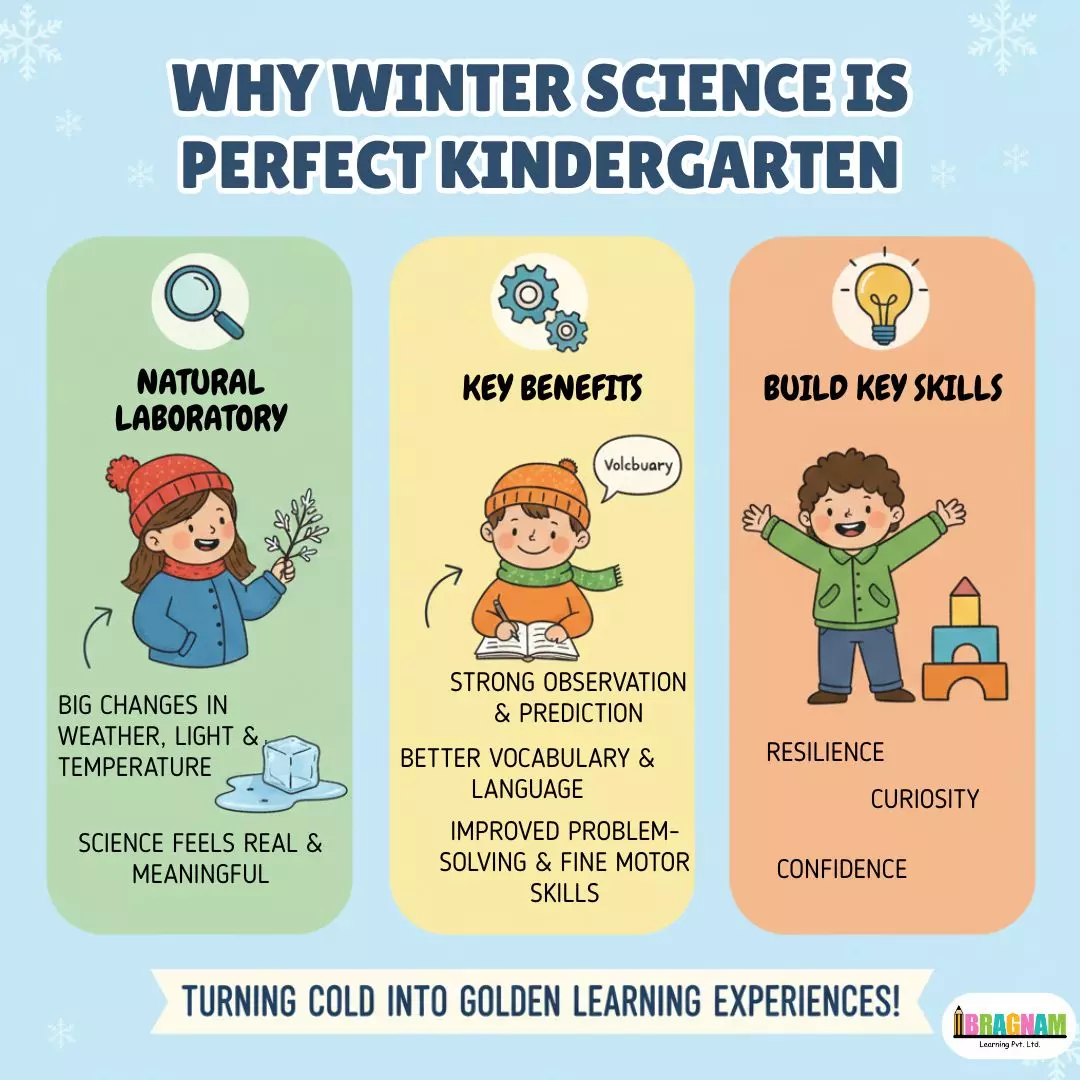
Winter gives a natural “laboratory” where children can see big changes in weather, light, and temperature, making science feel real and meaningful. Even in places without real snow, teachers can recreate winter experiences with ice, water, and sensory materials.
Key benefits for kindergarteners include:
Stronger observation and prediction skills
Better vocabulary and language development
Improved problem-solving and fine motor skills
These activities also support curiosity, resilience, and confidence as children test ideas and see what happens.
Learning Goals in Winter Science Exploration
Winter science exploration can support several early learning goals that align with kindergarten curricula.
Common goals include:
Observing and describing properties of materials (hot/cold, solid/liquid, rough/smooth)
Noticing and comparing changes over time (melting, freezing, dissolving)
Asking questions and making simple predictions (“What will happen if…?”)
Using simple tools such as droppers, cups, and magnifiers safely
These goals also link naturally with early literacy, as children talk about what they see, draw what happens, and dictate simple “science stories.”
Below are easy, classroom-friendly ideas you can run in small groups or at learning stations.
1. Melting Ice Exploration
Children explore how ice melts and what can make it melt faster.
You can:
Freeze colored ice cubes and place them in trays
Offer warm water, room-temperature water, and salt
Let children drip, pour, and sprinkle, then talk about what they notice
Concepts covered: states of matter, temperature, and cause-and-effect.
2. Snowstorm in a Jar (Snow-in-a-Bottle)
Even without real snow, children can create a “snowstorm” using a clear jar, water, oil, and small white particles like glitter or tiny foam bits.
Children shake the jar and watch how the “snow” falls and settles, building observation skills and language (“floating,” “sinking,” “swirling”).
3. Animal Tracks and Winter Animals
Use pictures, toy animals, or simple stamps to show how animals leave tracks in snow or mud.
Children can:
Press toy animal feet into playdough or salt dough “snow”
Match tracks to animals in picture cards
Talk about where animals go in winter and how they stay warm
This blends science with early environmental awareness and storytelling.
4. Paper Snowflakes and Symmetry
Folding and cutting paper snowflakes introduces basic geometry and symmetry in a hands-on way.
As children open their snowflakes, guide them to notice:
Matching sides and repeating shapes
Different patterns created by different cuts
This supports math skills like shape recognition, patterning, and spatial reasoning.
5. Winter Sensory Bins
Fill tubs with safe materials such as ice cubes, cotton balls, shredded paper, or gel beads to mimic “snow” and “ice.”
Add scoops, cups, and small toys for:
Pouring and transferring
Sorting objects by size, texture, or color
Creating simple winter stories and small-world play
These bins can be especially helpful for children with sensory needs when thoughtfully designed and supervised.
Safety Tips for Winter Science with Young Children
Safety is essential so that winter science exploration stays fun and stress-free for everyone.
Key safety practices:
Always supervise closely, especially around ice, water, and small loose parts
Avoid extremely hot or extremely cold materials; test temperatures beforehand
Use child-safe materials such as water, salt, baking soda, food colouring, and non-toxic craft items
Remind children about gentle hands, walking slowly, and not tasting the materials
Keep towels and spare warm clothing nearby for spills and wet sleeves
Clear safety routines help children feel secure and build good habits for future science learning.
Tips to Make Winter Science Exploration Meaningful
A few simple strategies can turn each activity into a rich learning experience.
Try to:
Start with a question: “What do you think will happen if we sprinkle salt on the ice?”
Encourage children to describe what they see, feel, and hear using full sentences
Add drawing or simple charts where children can record what they noticed
Connect activities to daily life (“How do we stay warm in winter?” “Where does water go when ice melts?”)
Linking winter science exploration with stories, songs, and circle-time discussions keeps learning integrated and memorable.
Integrating Winter Science into Your Kindergarten Day
Winter science exploration does not need to be a separate “big project.” It can fit into everyday routines.
Ideas for easy integration:
Morning circle: Talk about the weather and track temperature changes on a simple chart
Learning centres: Set up a “winter lab” table with rotating activities (ice melting one day, snowflakes the next)
Outdoor time: Look for frost, dew, puddles, shadows, and seasonal changes in plants and trees
This approach helps children see science as part of their real world, not just a “special subject.”
FAQ: Winter Science Exploration for Kindergarten
1. What is winter science exploration in kindergarten?
Winter science exploration is a set of playful, hands-on activities that help young children investigate ice, water, weather, and seasonal changes using simple materials and guided questions.
2. Are winter science activities safe for kindergarteners?
Yes, winter science activities are safe when adults supervise closely, use comfortable temperatures, and choose child-friendly ingredients like water, salt, baking soda, and food colouring.
3. Do we need real snow for winter science?
No, most winter science activities can be done with ice cubes, water, paper, and sensory materials, making them suitable for classrooms that do not get real snow.
4. What skills do children develop through winter science exploration?
Children develop observation, prediction, comparison, problem-solving, language skills, and fine motor control as they explore, test ideas, and describe what they see.
5. How often should I include winter science in my kindergarten plan?
Even one or two short winter science activities each week can make a big difference, especially when they are linked to stories, art, and outdoor observations.
Conclusion
Winter science exploration for kindergarten transforms cold days into warm, joyful learning moments where children feel like real scientists. With simple materials, clear safety routines, and curious questions, teachers and parents can nurture lifelong curiosity and confidence in young learners
By trrijesh|2025-12-01T14:02:29+05:302 December 2025|Blog|
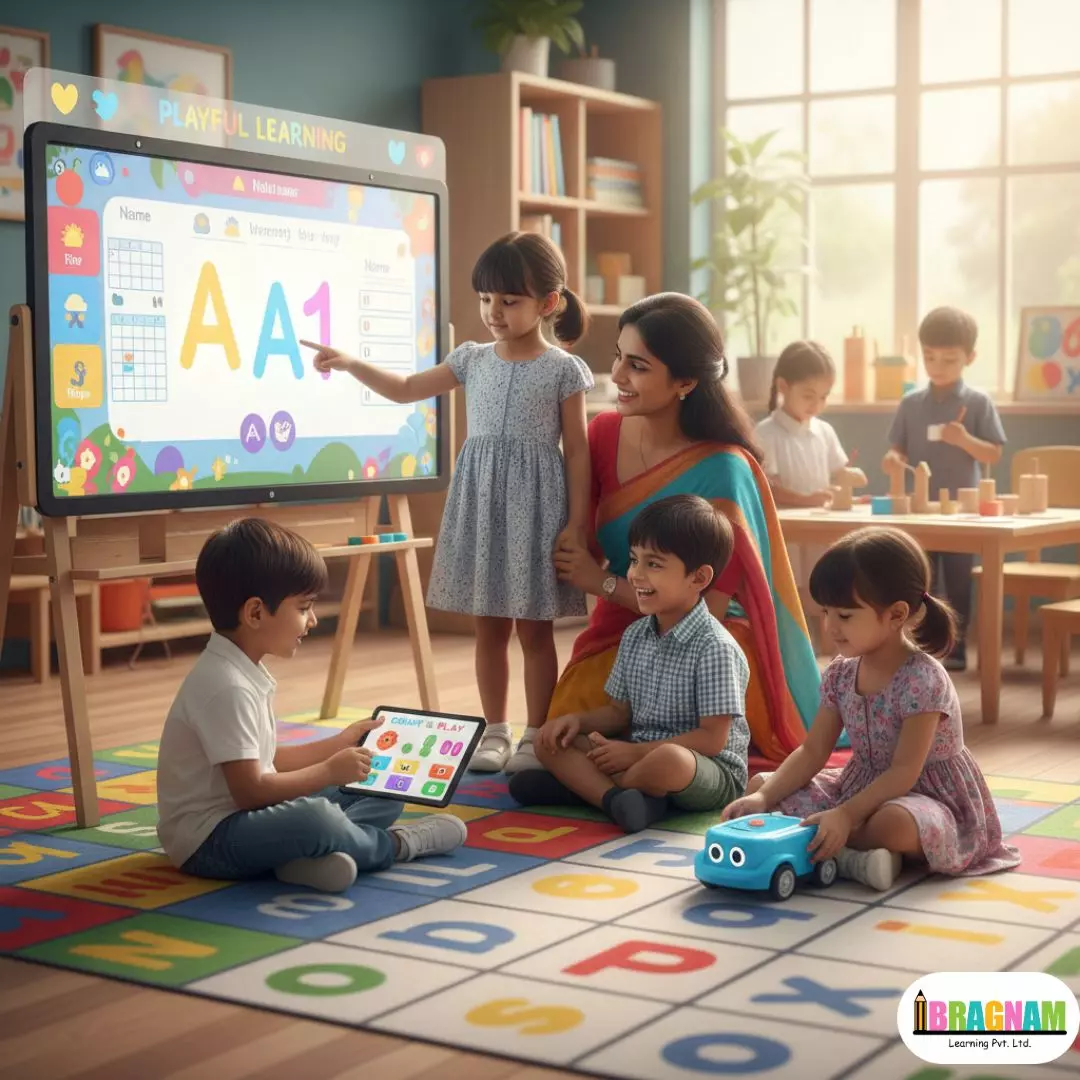
Technology in early childhood education can be a powerful tool to make learning more engaging, interactive, and personalised when used thoughtfully and in moderation. In a playschool setting, the right digital tools can support language, math, creativity, and social skills while still keeping play, movement, and hands-on exploration at the centre.
In a playschool, technology is not about long hours on screens or replacing teachers. It is about using age-appropriate tools that add value to children’s natural curiosity and play.
Common forms of technology in early childhood education include:
Tablets with carefully selected educational apps
Interactive whiteboards and digital displays
Audio devices for songs and stories
Simple coding and robotics toys for preschoolers
When integrated well, these tools become a part of the learning environment, just like blocks, books, and art materials.
Benefits of technology in early childhood education
Technology in early childhood education can enhance, not replace, traditional learning methods. Used wisely, it supports development across multiple domains.
Key benefits in a playschool setting:
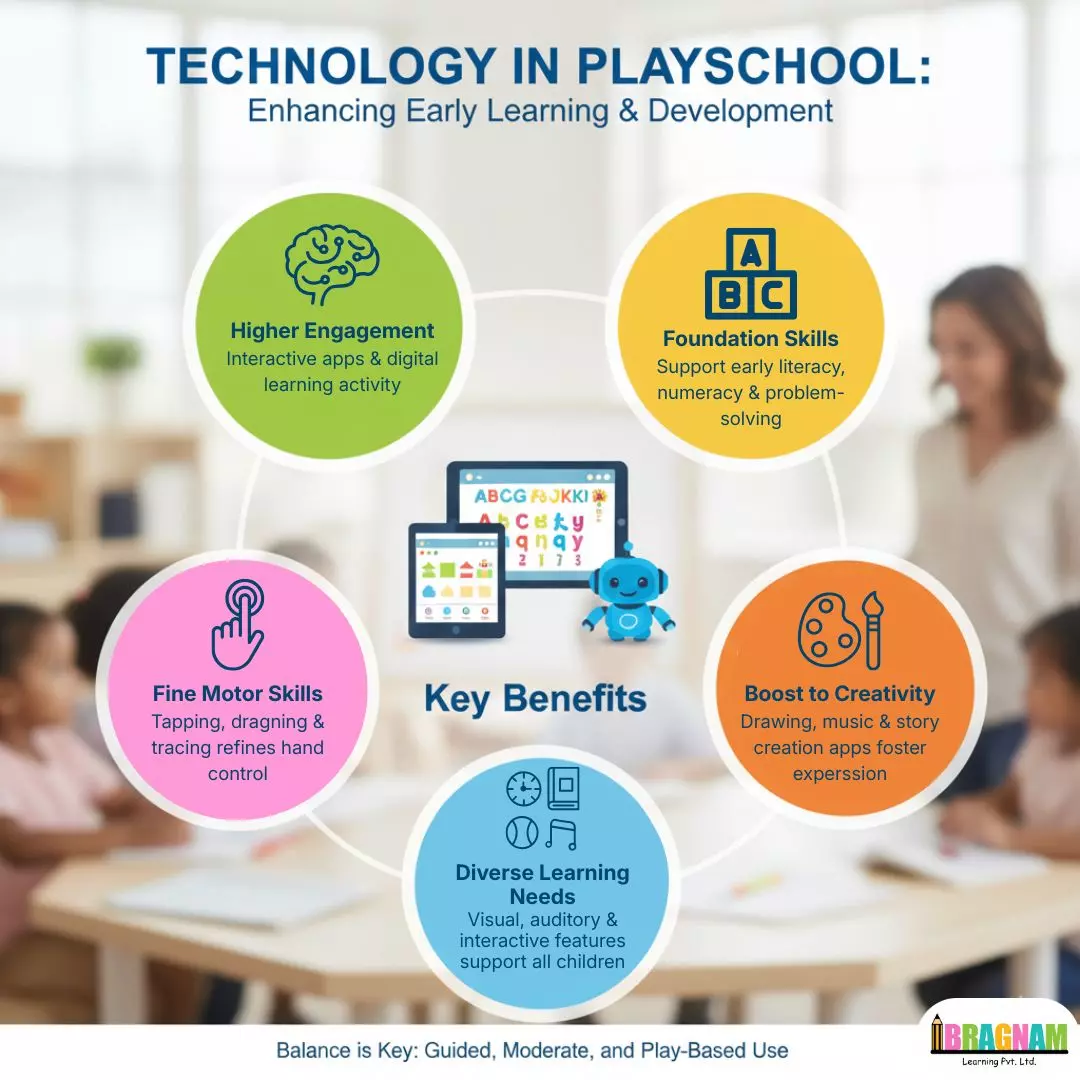
Higher engagement: Interactive apps, digital stories, and touch screens invite children to participate actively rather than passively watch.
Support for early literacy and numeracy: Phonics games, alphabet tracing, counting apps, and simple puzzles build foundational skills in a playful way.
Development of fine motor skills: Tapping, dragging, tracing shapes, and writing on interactive boards help refine finger and hand control.
Boost to creativity: Drawing apps, music tools, and story-creation software encourage children to express ideas in new formats.
Technology can also support children with different learning needs through visual, auditory, and interactive features.
Practical ways to use technology in a playschool classroom
Interactive whiteboards and digital displays
Interactive whiteboards are excellent for group learning and keeping children involved. They work best when they are used as a large, touchable “canvas” for learning, not just for showing videos.
Playschool teachers can use interactive boards to:
Run morning meetings with calendar, weather, name-writing, and letter-of-the-day activities.
Conduct read-aloud sessions where children help turn pages, circle letters, or act out parts of the story on screen.
Play interactive math and literacy games where children come up one by one to match shapes, count objects, or sort pictures.
Tablets and educational apps
Tablets are powerful tools in early childhood education if screen time and content are carefully controlled. They are best used for short, focused activities in small groups or one-on-one.
Examples of effective tablet use in a playschool:
Literacy apps: Interactive storybooks, phonics games, and letter-tracing apps that respond to children’s touch and voices.
Math and logic apps: Counting games, pattern-making, shape recognition, and simple problem-solving puzzles.
Creative tools: Drawing, colouring, music-making, and story-creation apps that let children design characters, record voices, or compose simple tunes.
Teachers should always pre-check apps to ensure they are ad-free, age-appropriate, and aligned with learning goals.
Digital storytelling and audio resources
Digital storytelling blends images, audio, and text to bring stories to life for young children. Children can listen, watch, and even help “build” the story.
Ways to use digital storytelling in early childhood education:
Play audio storybooks while children follow along with print books or images on a screen.
Let children record their own voices to narrate short stories, rhymes, or role-play dialogues.
Use photos or simple drawings from classroom activities to create class “digital books” about field trips, festivals, or projects.
These activities build vocabulary, listening, and confidence in communication.
Coding toys and robotics in early childhood education
Simple coding and robotics toys, designed for preschoolers, bring early computational thinking into playful experiences.
In a playschool, teachers can:
Introduce floor robots or coding toys where children press arrows to move the toy to a picture or letter on the mat.
Set up problem-solving challenges like “help the robot reach the red block in three steps.”
Encourage teamwork as children discuss and plan the robot’s path together.
These activities support logical thinking, sequencing, and collaboration without needing children to “use” a screen directly.
Balancing technology and play: healthy screen time habits
In early childhood education, balance is critical. Young children still need plenty of physical play, outdoor time, social interaction, and hands-on exploration.
Key healthy-use principles for technology in a playschool:
Limit total screen time: WHO guidance suggests no screen time for children under 1, and for ages 2–4, sedentary screen time should be kept to about an hour a day or less, with less being preferable.
Prioritise active use over passive watching: Choose activities where children touch, think, respond, and talk rather than simply watching videos.
Encourage movement breaks: Blend tech time with songs that involve actions, brain breaks, or movement games so children are not sitting for too long.
Playschools can also share screen-time guidelines with parents to support healthy habits at home.
Supporting teachers and parents through technology
The role of technology in early childhood education is not limited to children’s apps and tools. It can also strengthen communication and coordination among teachers and families.
Useful ways to use technology for adults in a playschool ecosystem:
Parent communication apps: Share photos, daily reports, announcements, and learning updates in a secure digital space.
Digital portfolios: Maintain records of children’s work—photos of activities, voice notes, videos—which can be reviewed during PTMs.
Online training for teachers: Access webinars, short courses, and resources on early childhood education and safe tech use.
When adults are confident and informed, technology becomes safer and more meaningful for children.
Safety, guidelines, and responsible use
To make technology in early childhood education safe and developmentally appropriate, playschools need clear rules and supervision.
Important safety measures:
Always use devices under adult supervision; children should not access open web content.
Disable in-app purchases, pop-up ads, and irrelevant notifications on classroom devices.
Choose tools with strong privacy policies and no requirement for children to share personal data.
Regularly reviewing tools and involving parents in discussions about technology helps maintain trust and transparency.
Conclusion: Technology as a supportive partner in early learning
Technology in early childhood education works best when it supports, not replaces, play-based learning and warm human relationships. In a playschool setting, thoughtful use of interactive whiteboards, tablets, audio tools, and coding toys can make concepts clearer, lessons more engaging, and communication with parents stronger—while still keeping children active, curious, and joyful.
When playschools follow clear screen-time guidelines, choose quality content, and keep experiences playful and hands-on, technology becomes a powerful partner in building strong early foundations.
FAQs: The Role of Technology in Early Childhood Education
1. Is technology really necessary in early childhood education? Technology is not mandatory, but it can significantly enrich early learning when used in short, purposeful activities that match children’s developmental levels. It offers interactive, visual, and auditory experiences that can strengthen literacy, numeracy, and problem-solving skills.
2. How much screen time is safe for playschool children? WHO recommends no sedentary screen time for children under 1 year and no more than about 1 hour per day for children 2–4 years old, with less being better. Playschools should use technology in brief, high-quality sessions and combine it with plenty of physical play, art, and outdoor activities.
3. What types of apps are best for preschoolers? The best apps for early childhood education are ad-free, age-appropriate, and focused on active learning—such as interactive storybooks, phonics games, early math puzzles, and creative drawing or music tools. Apps should encourage children to think, respond, and create rather than passively watch.
4. Can technology harm young children’s development? Excessive or unsupervised screen time can contribute to reduced physical activity, weaker social interaction, and attention difficulties. However, when screen time is limited, supervised, and focused on high-quality educational content, technology can support healthy development.
5. How can playschools involve parents in technology use? Playschools can use communication apps and digital portfolios to share photos, videos, and updates on children’s learning with families. They can also share simple screen-time guidelines and app recommendations so that technology at home supports, rather than conflicts with, classroom practices.
Holiday themed crafts for playschool franchises bring joy and creativity into classrooms, helping young children explore festivals through hands-on fun. These activities boost fine motor skills, cultural awareness, and excitement during seasons like Christmas, Diwali, and more. Perfect for franchise owners, they create memorable experiences that parents love sharing on social media.
Why Holiday Crafts Matter in Playschools
Holiday themed crafts for playschool franchises engage toddlers and preschoolers in sensory play while teaching traditions. Simple materials like paper, glue, and paint keep costs low for multiple centers. Franchises see higher parent satisfaction when kids bring home unique decorations.
These crafts fit busy schedules, taking 15-30 minutes each. They encourage teamwork and self-expression without overwhelming setup.
Paper Plate Christmas Trees: Cut a paper plate into a triangle, paint it green, and add pom-poms or buttons for ornaments. Kids glue on a star topper for a festive tree.
Handprint Reindeer Cards: Dip little hands in brown paint for the reindeer’s head, add googly eyes and a red pom-pom nose. Draw antlers with markers—parents treasure these keepsakes.
Cotton Ball Snowmen: Outline a snowman on paper, let children glue fluffy cotton balls for the body, then add details like a scarf and hat.
Salt Dough Ornaments: Mix flour, salt, and water into dough, cut shapes, bake low, and paint. Poke a hole for hanging ribbons.
These build fine motor skills and holiday cheer across franchise locations.
Diwali Crafts for a Festival of Lights
Diwali delights kids with colorful holiday themed crafts for playschool franchises rooted in Indian traditions.
Paper Diya Lanterns: Fold colored paper into diya shapes, decorate with glitter and stickers, then add a battery tea light inside for safe glow.
Handprint Rangoli: Dip hands in paint for floral patterns on paper, or use torn colored paper scraps for textured designs.
Marigold Garlands: Scrunch orange crepe paper into flowers, string them with yarn for door hangings.
Torn Paper Diya Collage: Tear vibrant paper bits to fill a diya outline, adding gold glitter for shine.
These crafts teach light’s symbolism while being mess-free for group activities.
Halloween and Holi Fun for All Seasons
Broaden your holiday themed crafts for playschool franchises with global and seasonal twists.
Halloween Spooks
Paper Plate Masks: Cut eyes from plates painted orange for pumpkins or black for cats, attach straw handles.
Spider Web Art: Draw webs with white crayon on paper, paint over with watercolors to reveal patterns.
Holi Colors
Use washable paints for handprint rangoli or balloon tosses, adapting to safe, vibrant play.
These keep franchises versatile year-round.
New Year Crafts to Welcome Fresh Starts
Ring in the new year with bubbly holiday themed crafts for playschool franchises.
DIY Confetti Poppers: Cover toilet rolls with balloons, fill with punched paper confetti, and pop for cheers.
Popsicle Stick Noisemakers: Glue sticks into frames, add beads inside, and decorate with paint.
Beaded Garlands: String bells and beads on yarn for jingly decor.
Kids practice patterns and sounds, perfect for countdown parties.
Tips for Franchise Owners
Stock shared kits with glue sticks, construction paper, pom-poms, and glitter across centers. Rotate crafts weekly to match local holidays. Photograph sessions for franchise social media to attract enrollments. Safety first: supervise scissors and use non-toxic supplies.
Involve parents via WhatsApp shares of finished crafts.
FAQ
What materials do I need for holiday themed crafts for playschool franchises?
Basic supplies like paper plates, colored paper, glue, paint, pom-poms, and googly eyes work for most. They’re affordable in bulk for franchises.
How long do these crafts take for preschoolers?
Most take 15-30 minutes, ideal for short attention spans. Prep ahead for smooth sessions.
Are these crafts safe for 2-3-year-olds?
Yes, use large pieces, non-toxic paints, and adult supervision. Avoid small parts.
Can holiday themed crafts for playschool franchises teach culture?
Absolutely—they introduce traditions like Diwali lights or Christmas trees playfully.
How to store crafts in franchise settings?
Use clear bins labeled by holiday. Display on walls or send home in folders.
Bragnam playschool franchises thrive with these holiday themed crafts—plan your next session today! Share your kids’ creations in comments or contact us for franchise craft kits.
By trrijesh|2025-11-29T17:29:49+05:3029 November 2025|Blog|
Introduction: Why Montessori belongs in your playschool
Montessori education is a child-centred approach that focuses on self-directed activity, hands-on learning, and collaborative play instead of rote teaching. In a Montessori-inspired playschool, children are seen as naturally eager to learn and capable of choosing meaningful activities when the environment is thoughtfully prepared.
For playschool owners and educators, embracing Montessori is not about changing everything overnight; it is about gradually creating a space where independence, curiosity, and respect guide every decision. This shift not only improves daily classroom life but also lays a powerful foundation for lifelong learning skills such as problem-solving, focus, and emotional resilience.
What is the Montessori method? The Montessori method was developed by Dr. Maria Montessori, an Italian physician who observed that children learn best through exploration, movement, and purposeful work. Her approach views education as a holistic process that supports cognitive, social, emotional, and physical development together, rather than treating academics separately.
At its core, Montessori education respects each child’s pace and personality, allowing them to progress when they are ready instead of following a strict one-size-fits-all schedule. This flexibility is particularly powerful in playschools, where early experiences often shape how children feel about learning for years to come.
Key Montessori principles for your playschool When embracing Montessori as a foundation for lifelong learning in your playschool, a few core principles will guide your planning and training. These principles can be implemented step by step, even if your school is not yet fully Montessori.
Some essential Montessori principles are:
Respect for the child as an individual learner
The “absorbent mind” in early childhood
Sensitive periods for rapid learning
A carefully prepared environment
Auto-education (children teaching themselves through exploration)
By aligning your playschool with these principles, you create a setting where children feel trusted, capable, and motivated to take charge of their own learning journey.
The prepared environment: your silent teacher
Montessori classrooms are often described as “prepared environments” because every shelf, material, and routine is intentionally designed to support independent learning. In a playschool, this means child-sized furniture, accessible materials, and clearly defined learning areas such as practical life, sensorial, language, math, and culture.
A well-prepared Montessori environment helps children:
Choose activities independently
Move freely while respecting others
Return materials to their place after use
Develop concentration through uninterrupted work time
When your environment functions smoothly, the room itself becomes a “silent teacher,” guiding children to explore, repeat, and master skills at their own pace.
Mixed-age groups: learning from each other
Montessori playschools usually group children in mixed-age classrooms (for example, ages 3–6 together) rather than strict single-age sections. This structure mirrors real life, where different ages interact naturally, and gives each child the chance to be both learner and mentor over time.
In mixed-age Montessori groups:
Younger children observe and imitate older peers
Older children build confidence by helping younger ones
Teachers can individualize lessons instead of teaching to the “average”
A sense of community and empathy develops organically
This peer learning plays a big role in building social skills and leadership qualities that support lifelong learning and collaboration later in school and work.
Practical life activities: real skills for real life
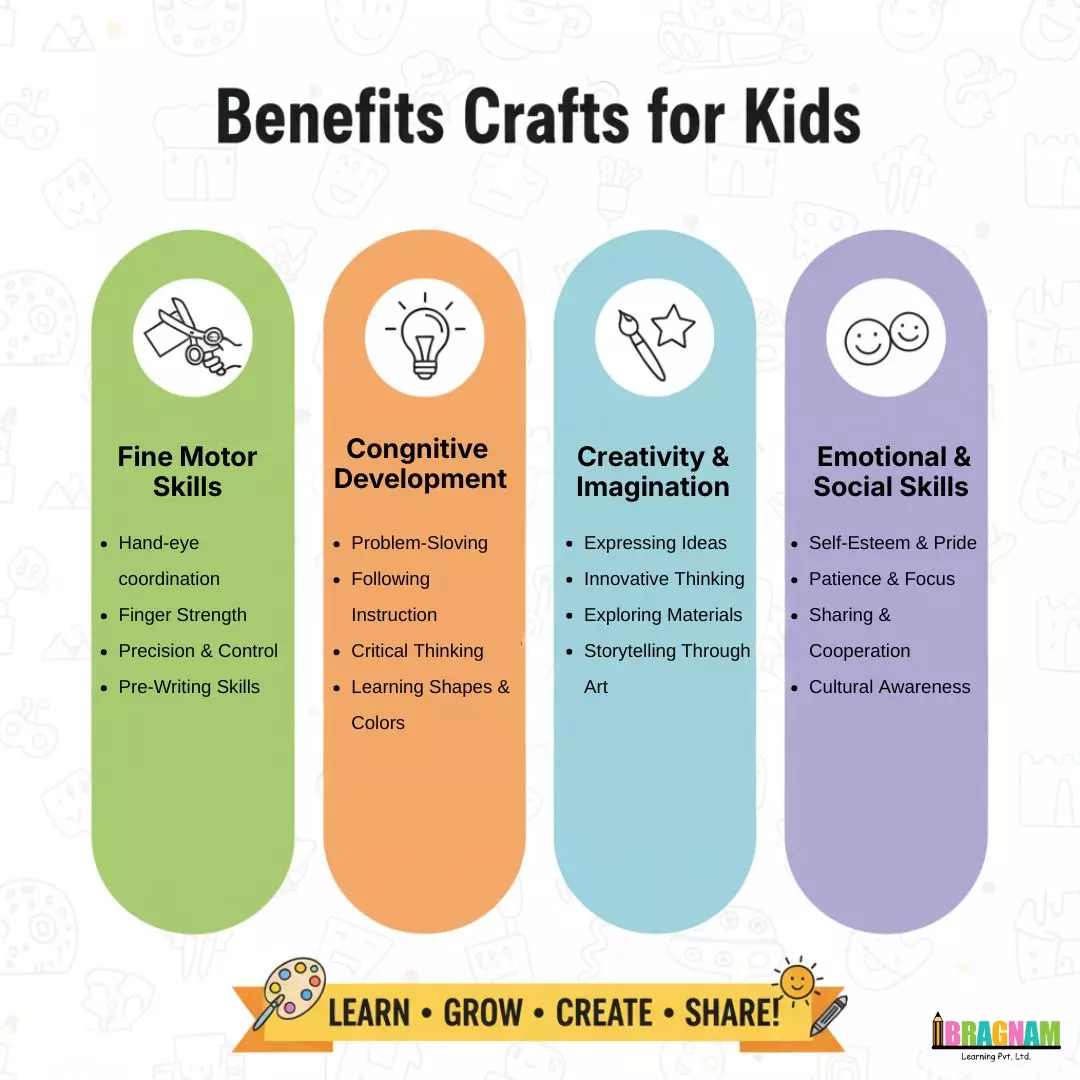
Practical life activities are a hallmark of Montessori and fit beautifully in any playschool environment. These are everyday tasks—pouring water, buttoning, sweeping, setting the table—that children love to repeat, and that quietly build concentration, coordination, and independence.
Well-designed practical life corners help children:
Care for themselves (dressing, washing hands, organising belongings)
Care for the environment (watering plants, cleaning tables, arranging shelves)
Develop fine motor skills for writing and art
Feel proud of meaningful contributions to the classroom
When children feel capable in daily routines, they approach academic tasks with more confidence and a stronger sense of responsibility.
Well-designed practical life corners help children:
Care for themselves (dressing, washing hands, organising belongings)
Care for the environment (watering plants, cleaning tables, arranging shelves)
Develop fine motor skills for writing and art
Feel proud of meaningful contributions to the classroom
When children feel capable in daily routines, they approach academic tasks with more confidence and a stronger sense of responsibility.
Freedom within limits: gentle structure that builds discipline
One of the most powerful ideas in Montessori is “freedom within limits.” Children are free to choose activities, move around the room, and repeat work—but within clear, consistent boundaries that keep everyone safe and focused.
In a Montessori-inspired playschool, freedom within limits might look like:
Choosing any material from a shelf, but using it in the way it was designed
Working on the floor or at a table, but not disturbing others
Moving around the room, but returning materials and walking carefully
This balanced approach helps children practise decision-making, self-control, and respect for others—key ingredients for lifelong learning and positive behaviour in higher classes.
The teacher as a guide, not a lecturer
In Montessori, teachers are often called “guides” because their primary role is to observe children, connect them with the right materials, and step back to let them explore. Instead of leading the entire class in the same activity, Montessori guides quietly demonstrate lessons to individuals or small groups and then allow children to practise independently.
For your playschool team, embracing this role means:
Spending more time observing than talking
Preparing and refreshing materials regularly
Intervening gently only when truly necessary
Encouraging children to solve problems on their own first
This approach nurtures confidence and intrinsic motivation, helping children develop the mindset of lifelong learners who are not afraid to try, fail, and try again.
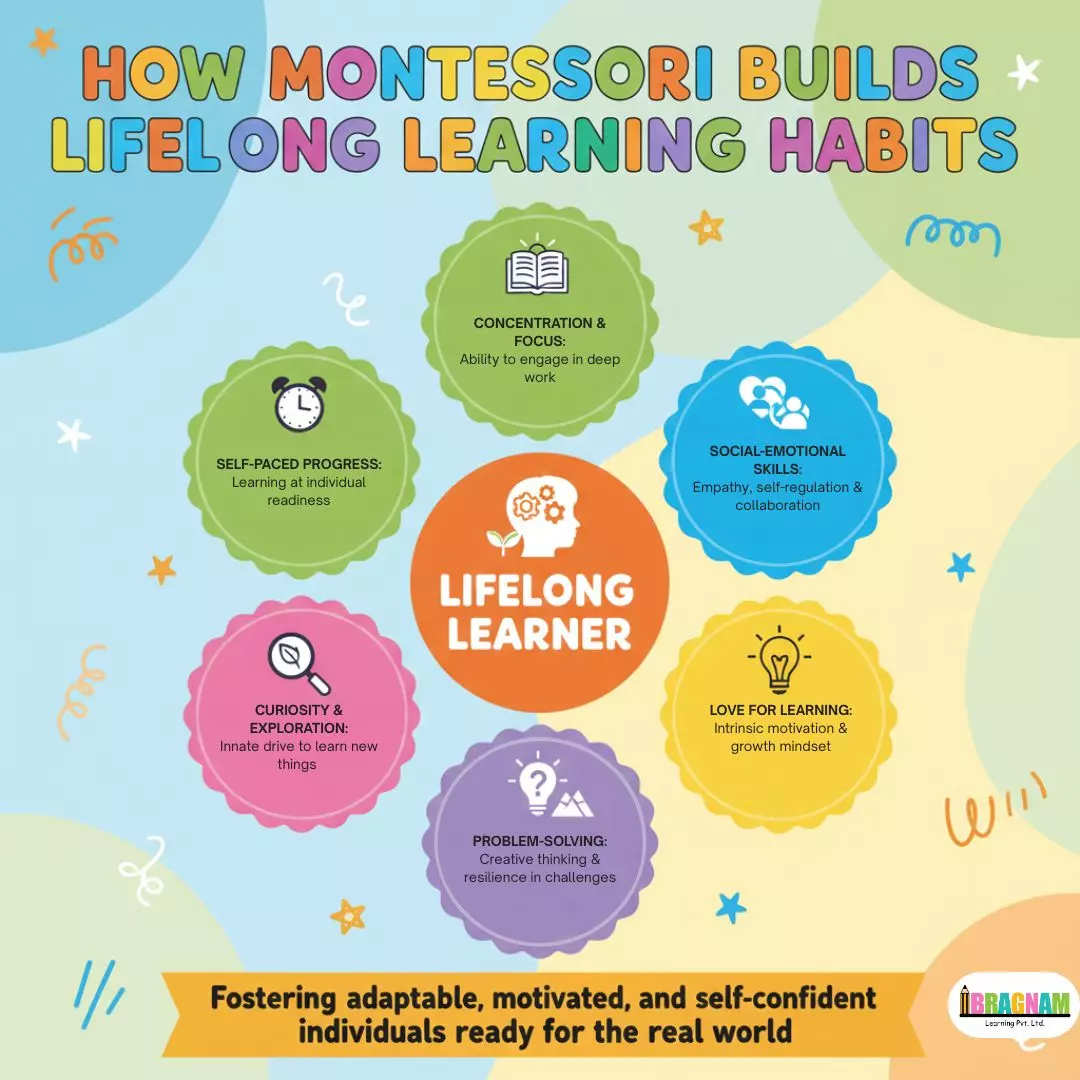
How Montessori builds lifelong learning habits
When you bring Montessori principles into your playschool, you are doing much more than improving classroom behaviour or making your space look attractive. You are actually shaping long-term attitudes, habits, and skills that carry forward into primary school, secondary school, and adult life.
Research and school experiences show that Montessori-educated children often:
Show stronger concentration and problem-solving skills
Demonstrate better social-emotional skills such as empathy and self-regulation
Display creativity and curiosity in new situations
Maintain a genuine love for learning and exploration
These qualities prepare children not just for exams, but for real-world challenges where adaptability, collaboration, and self-motivation are essential
Practical steps to embrace Montessori in your playschool You can start embracing Montessori in your playschool gradually, without immediately transforming into a fully certified Montessori school. Focus on small, consistent steps that align with your budget, team, and existing curriculum.
Some practical starting points include:
Redesigning shelves so that materials are open, accessible, and neatly arranged at child height.
Introducing a few basic Montessori-inspired practical life activities like pouring, spooning, dressing frames, and simple food preparation.
Training teachers on observation, guiding rather than lecturing, and using gentle language that supports independence.
Establishing longer, uninterrupted work periods where children can settle into activities without frequent transitions.
Creating simple classroom rules that explain freedom within limits in child-friendly terms.
As your team gains confidence, you can gradually add sensorial, language, and math materials that deepen Montessori practice in your playschool.
Simple comparison: traditional vs Montessori-style playschool
Aspect
Traditional playschool approach
Montessori-style playschool approach
Classroom structure
Whole-class activities led by teacher at fixed times
Children choose activities in a prepared environment at their own pace
Age grouping
Single-age groups (e.g., only 3-year-olds)
Mixed-age groups that learn from each other (e.g., 3–6 years)
Role of teacher
Instructor who explains and directs most activities
Guide who observes, introduces materials, and supports independence
Learning materials
Worksheets, toys, and theme-based crafts
Self-correcting, hands-on materials for practical life and academics
View of the child
Learners who follow instructions
Active explorers capable of self-directed learning
Discipline approach
External rules and rewards
Freedom within limits and self-discipline through choice
This shift from “teaching everything” to “supporting independent learning” is what makes embracing Montessori a powerful foundation for lifelong learning in your playschool.
Conclusion: Make Montessori your playschool’s learning DNA Embracing Montessori as a foundation for lifelong learning in your playschool is ultimately about honouring the way young children naturally learn—through exploration, choice, and meaningful work. With a prepared environment, mixed-age groups, practical life activities, and teachers who guide rather than control, your playschool can nurture children who are confident, curious, and ready to learn for life.
Instead of simply offering “school readiness,” your playschool can become a place where children discover who they are as learners—and carry that love of learning wherever they go next.
Ready to start embracing Montessori in your playschool? Begin with one classroom, one shelf, or one new routine, and watch how small changes transform children’s engagement and joy in learning.
FAQ section
1. What is Montessori and how can it fit into my playschool?
Montessori is an educational approach that focuses on self-directed learning, hands-on activities, and respect for each child’s pace of development. In your playschool, you can fit Montessori in by preparing child-friendly environments, offering practical life activities, and giving children more choice within clear limits.
2. Why is Montessori a strong foundation for lifelong learning in playschool?
Montessori builds lifelong learning skills by encouraging curiosity, concentration, and problem-solving from an early age. Children who experience Montessori often develop independence, resilience, and a genuine love for learning that supports them in later schooling and life.
3. Do I need to change my entire curriculum to embrace Montessori?
You do not need to change everything at once to embrace Montessori in your playschool. Start with small steps like reorganising the classroom, adding practical life activities, and training teachers to act more as guides than lecturers.
4. Are Montessori materials expensive for a playschool to adopt?
Some specialised Montessori materials can be costly, but many foundational practical life and sensorial activities can be created using everyday items. Playschools often begin with simple, budget-friendly setups and gradually invest in more materials as demand and resources grow.
5. How can parents see the benefits of Montessori in my playschool?
Parents usually notice that their children become more independent, responsible, and enthusiastic about coming to school. You can highlight Montessori benefits through parent orientations, classroom observations, and regular communication about how activities support lifelong learning skills.
By trrijesh|2025-11-28T15:34:20+05:3028 November 2025|Blog|
Boosting Social Skills: Helping Kindergarteners Make Friends and Build Relationships
Boosting social skills in kindergarten is essential for helping children develop the confidence to make friends and build meaningful relationships. From classroom activities to home routines, boosting social skills supports lifelong emotional and academic success.
This guide explores why social-emotional development is essential and provides simple, effective strategies to help young learners build lasting friendships and healthy relationships.
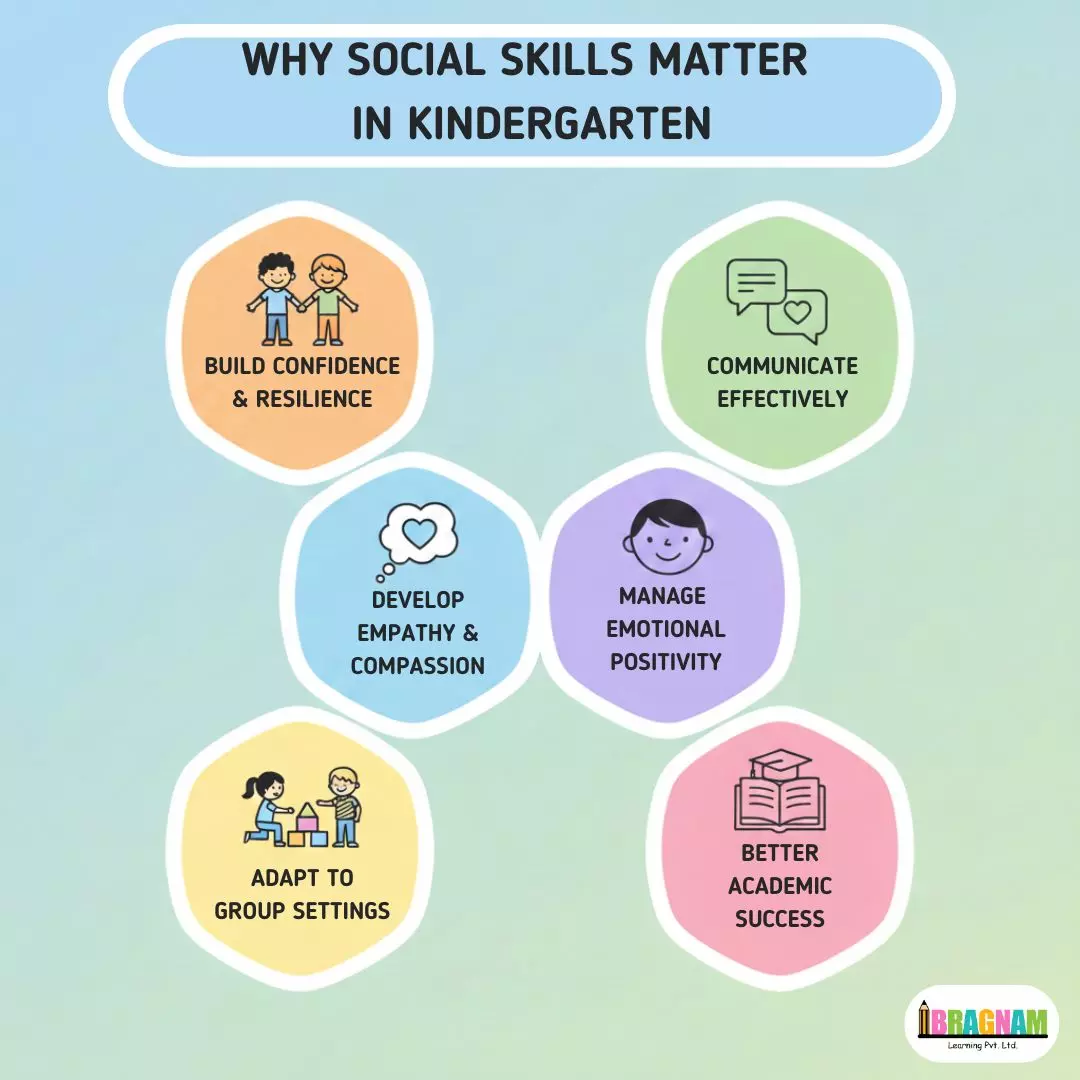
Boosting Social skills go far beyond learning how to say “hello” or “please.” They shape how children understand emotions, resolve conflicts, and work with others. Strong social-emotional development helps children:
Develop empathy and compassion
Communicate effectively with peers and adults
Build self-confidence and resilience
Manage emotions in positive ways
Adapt to group settings with cooperation and respect
According to research by the Collaborative for Academic, Social, and Emotional Learning (CASEL), children with well-developed social-emotional skills tend to perform better academically, have better mental health, and show improved behavior throughout school years.
Understanding Social and Emotional Development
Boosting social skills involves nurturing:
1. Self-awareness and Emotion Recognition
Children identify feelings and learn emotional regulation, a key aspect of boosting social skills in kindergarten.
2. Social Interaction and Empathy
Empathy and positive social interactions are central to boosting social skills. Activities that encourage respect and sharing reinforce these abilities.
3. Relationship-Building
Building friendships is the end goal of boosting social skills, empowering children to cooperate and resolve conflicts.
When these skills develop together, they create a foundation for emotional intelligence and lifelong social confidence.
Practical Strategies for Boosting Social Skills in Kindergarten
Parents and educators can play a key role in guiding children to build strong social connections. Here are some actionable strategies to use at home or school.
1. Create Opportunities for Cooperative Play
Structured group activities naturally encourage teamwork and communication. Activities such as building blocks, art projects, or role-playing games teach children how to share, negotiate, and express ideas.
Examples of group games:
Building a puzzle together
Pretend play (e.g., “let’s open a shop”)
Music and dance sessions
2. Model Positive Behavior
Children learn by observing adults. Use kind words, practice patience, and show respect in everyday interactions. Modeling good manners and empathy helps children mirror those behaviors with peers.
3. Encourage Emotional Expression
Ask open-ended questions like “How did that make you feel?” or “What do you think your friend felt?” This helps children verbalize emotions and develop empathy for others.
4. Teach Problem-Solving Skills
Small conflicts are part of daily life in kindergarten. Teach children to use calm strategies—such as talking it out, taking turns, or asking a teacher for help. The goal is to guide them toward independent conflict resolution.
5. Celebrate Kindness and Cooperation
Positive reinforcement encourages repetition. Praise children when they share, comfort a friend, or include someone new in play. Recognizing kind actions boosts confidence and social initiative.
Building Social Skills Through Classroom Activities
Teachers can make social learning part of everyday classroom life. Here are a few ideas:
Circle Time Conversations
Create a morning routine where children sit together, share news, and greet peers. This builds communication skills and strengthens teacher-child relationships.
Storytelling and Role Play
Use age-appropriate stories that illustrate emotions, friendship, and teamwork. Follow up with role-playing activities to help children understand how to act kindly in real-life situations.
Partner and Group Tasks
Assign tasks in pairs or small groups to promote cooperation and inclusion. Children learn to value others’ opinions while improving teamwork.
Emotion Cards and Games
Visual tools like “feelings cards” help children recognize emotions in themselves and others—an essential step in emotional regulation.
The Role of Parents in Social Development
Parents are a child’s first teachers, and their influence continues even after school begins. To support children socially:
Arrange playdates or group activities with other children
Offer praise when your child makes friends or helps others
Discuss daily interactions—listen without judging
Teach and reinforce empathy by talking about feelings
Limit screen time to allow more personal engagement
When children experience consistent support from both home and school, they gain confidence and emotional balance.
Long-Term Benefits of Strong Social Skills
Children who master social skills early experience benefits that extend beyond kindergarten:
Better classroom participation and teamwork
Greater self-regulation and focus
Improved emotional intelligence
Stronger friendships and reduced loneliness
Long-term success in academics and personal growth
Building friendships may seem simple, but the underlying skills—empathy, communication, and cooperation—prepare children for thriving in school and life.
Frequently Asked Questions (FAQs)
1. Why are social skills important in kindergarten?
Social skills help children connect with peers, express themselves clearly, and adapt to group environments. These abilities form the base for emotional and academic growth.
2. How can parents teach social skills at home?
Parents can model kindness, host playdates, encourage teamwork activities, and discuss emotions openly to foster empathy and cooperation.
3. What if my child struggles to make friends?
Encourage small steps, like greeting peers or joining group activities. Offer gentle coaching and build confidence through shared experiences.
4. How do teachers support social-emotional development?
Teachers use cooperative games, circle time discussions, and role-play to help students recognize emotions and interact positively with others.
5. What are good books for teaching friendship?
Titles like “The Rainbow Fish” by Marcus Pfister and “Have You Filled a Bucket Today?” by Carol McCloud are excellent for discussing empathy and sharing.
Conclusion: Nurturing Connection and Confidence
Boosting social skills in kindergarten helps children thrive not only in academics but in life. By encouraging kindness, empathy, and cooperation, parents and teachers can guide children toward healthy friendships and emotional well-being.
Remember, every gentle nudge, shared story, or kind conversation contributes to a child’s ability to connect confidently with others.
By trrijesh|2025-11-26T16:04:35+05:3026 November 2025|Blog|
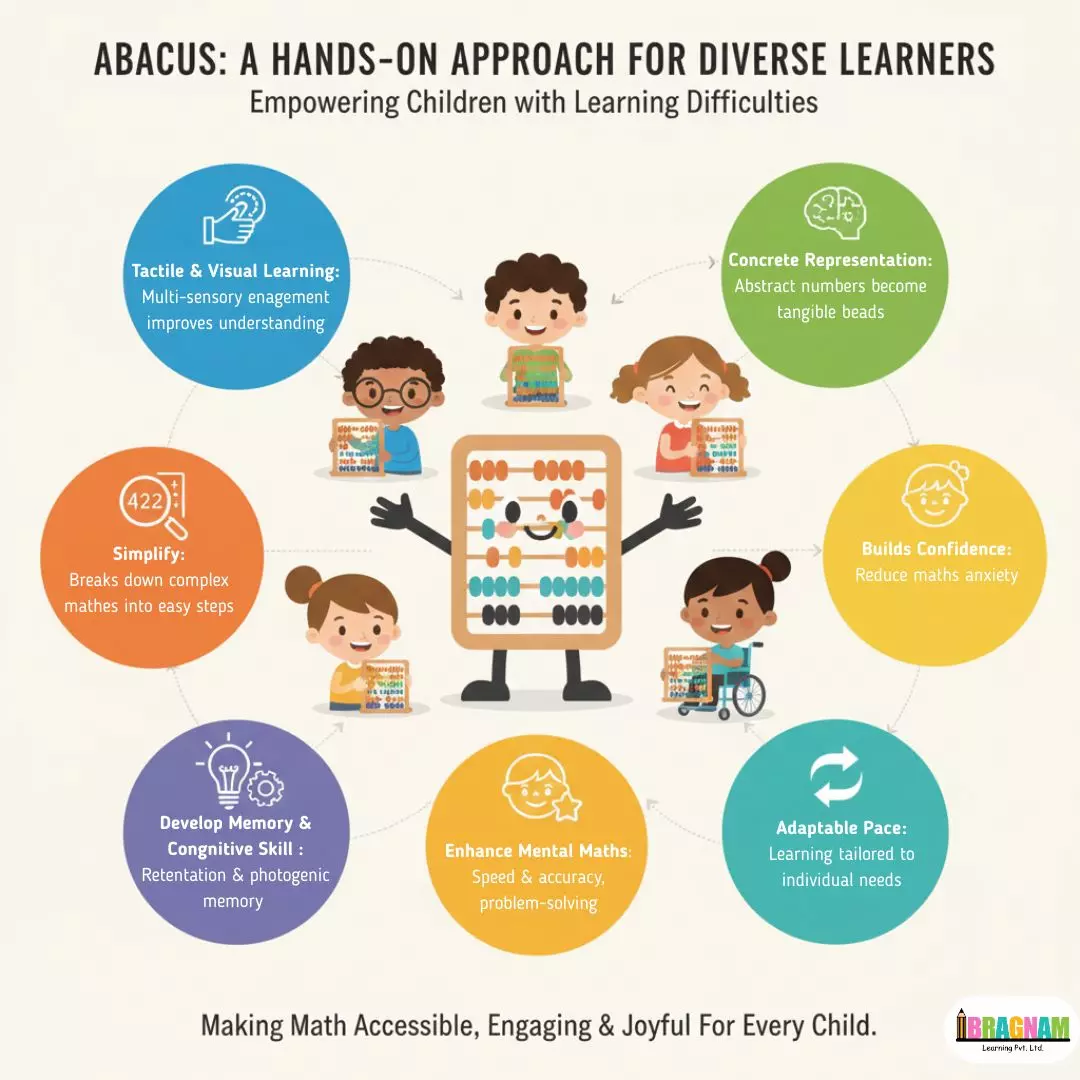
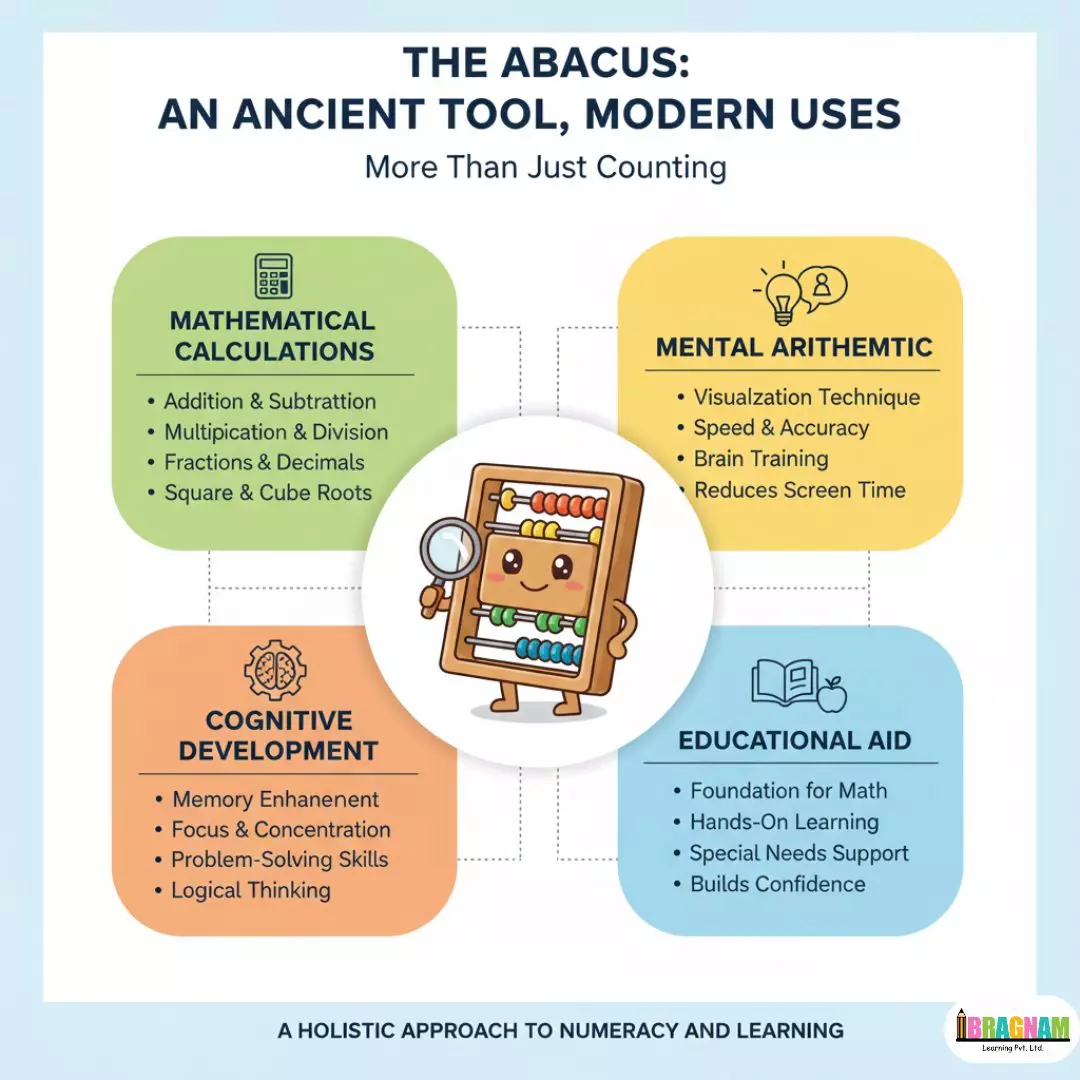
Learning abacus is much more than mastering a simple counting tool; it is an engaging way to boost mental math skills, develop cognitive abilities, and cultivate essential life skills for children. As a hands-on learning experience, abacus education helps children improve concentration, memory, problem-solving, and logical thinking in a fun and interactive way. This blog will explore the illuminating benefits of learning abacus, why it matters for children, and how it can support their academic and personal growth.
What is an Abacus?
The abacus is an ancient counting frame used for mathematical calculations. By moving beads along rods, learners visualize numbers and perform arithmetic operations like addition, subtraction, multiplication, and division. This tool enhances mental calculation skills while developing concentration and memory through tactile and visual learning.
Key Benefits of Learning Abacus
Enhances Mental Calculation Skills
The abacus trains children to visualize numbers internally, allowing mental calculation with speed and accuracy.
Enhances understanding of number patterns and relationships.
Builds proficiency in solving complex mathematical problems quickly.
Improves listening skills and ability to follow instructions.
Develops Memory and Cognitive Skills
Engages both auditory and visual memory pathways.
Increases retention capacity for numbers and sequences.
Enhances photographic memory through repeated mental arithmetic.
Cultivates Problem-Solving and Critical Thinking
Enables children to break down complex problems into manageable steps.
Encourages logical reasoning and analytical thinking.
Develops multitasking ability and mental alertness.
Improves Speed and Accuracy
Practice with abacus speeds up calculation time.
Promotes accuracy in numerical operations.
Builds confidence by reducing math anxiety.
Enhances Hand-Eye Coordination and Motor Skills
Coordinating bead movements enhances fine motor skills.
Develops greater eye-hand coordination crucial for various tasks.
Fosters Social Skills and Confidence
Group learning encourages cooperation, teamwork, and communication.
Boosts self-esteem as children gain mastery over math concepts.
Additional Advantages
Helps develop creativity and visualization skills.
Suitable for children with learning difficulties, making math accessible via tactile methods.
Prepares children with important skills for academic success and lifelong learning.
FAQ Section
1. At what age can a child start learning abacus?
Children can start learning as early as 4 to 5 years old, which helps build foundational number sense and calculation skills.
2. Does abacus learning help with school mathematics?
Yes, abacus learning enhances mental math abilities that translate directly into better performance in school arithmetic and problem-solving.
3. How long does it take to see improvement from abacus training?
With regular practice, noticeable improvements in calculation speed and concentration can show within a few months.
4. Can abacus help children with learning difficulties?
Absolutely, the visual and tactile approach aids children facing challenges with traditional math learning methods.
5. Is abacus learning useful for adults too?
Yes, adults can also benefit by improving mental agility, calculation skills, and cognitive function.
Conclusion
Learning the abacus provides children with a rich blend of cognitive, social, and academic benefits. From enhancing mental calculation skills and concentration to boosting memory and problem-solving abilities, abacus training equips children with vital tools for lifelong success. Beyond improving math skills, abacus fosters confidence and creativity, making math fun and accessible while preparing young learners for future challenges. Encouraging your child to learn abacus can be an excellent investment in their overall development.
By trrijesh|2025-11-25T12:16:01+05:3025 November 2025|Blog|
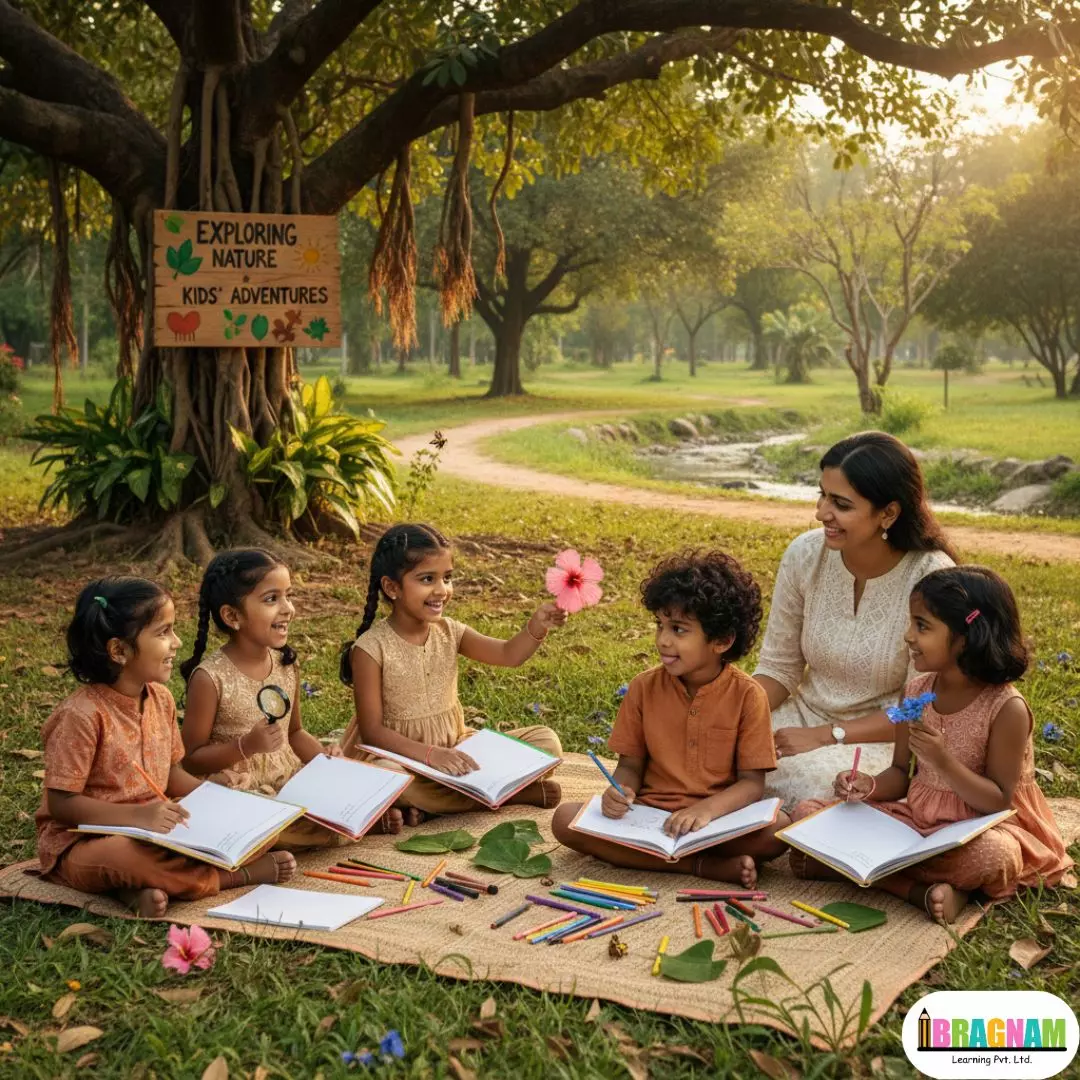
Nature is one of the best teachers for young children. For kindergarten kids, exploring nature opens up a world full of colors, textures, sounds, and fascinating discoveries. Whether they are observing plants, watching tiny insects, or listening to birds, children naturally become curious learners. Encouraging kids to write about their experiences in nature not only builds early writing skills but also promotes awareness, creativity, and a love for the environment.
In this article, we explore the importance of nature-based writing for young learners, simple ways to introduce it, and fun activities that inspire imagination. Parents and teachers can use these ideas to make “Exploring Nature” meaningful, joyful, and educational.
Why “Exploring Nature” Is Important for Kindergarten Kids
Children between 3–6 years are naturally curious. Nature provides endless opportunities to observe, touch, smell, and learn.
Key Benefits
Enhances observation skills Kids learn to notice details like leaf shapes, flower colors, tiny insects, or the sound of wind.
Boosts vocabulary development Nature adds new words to their daily language—roots, petals, nest, soil, wings, bark, and more.
Encourages creativity and imagination Describing nature scenes helps kids build interesting stories and picture-based descriptions.
Builds environmental awareness Kids understand the importance of plants, animals, and ecosystems from a very young age.
Improves writing and communication skills Expressing their feelings and experiences helps them form simple sentences and clear ideas.
How to Introduce “Exploring Nature” Writing to Kindergarteners
Let them observe freely before discussing anything.
2. Encourage Observation Using the Five Senses
Guide kids to explore nature through:
What they see: plants, trees, insects
What they hear: birds, rustling leaves
What they smell: flowers, soil
What they touch: smooth leaves, rough bark
What they feel: warmth of the sun, soft breeze
This helps make writing more expressive.
3. Encourage Kids to Complete Simple Starter Sentences
To make writing easier, give children incomplete sentences that they can finish on their own, such as:
“I saw a __________ in the garden today.”
“My favorite thing in nature is __________.”
“The tall tree looked like __________.”
“I felt happy when I saw __________.”
These easy sentence starters help children express their experiences clearly.
4. Use Drawing Before Writing
Drawing is a crucial step for kindergarten kids. Encourage them to draw:
Their favorite plant
A butterfly
A tree
The sky or clouds
Then help them write 1–2 simple sentences describing their artwork.
5. Create a Nature Journal
Give each child a nature notebook where they can:
Stick leaves
Draw flowers
Paste pictures
Write words or short sentences
Record what they observed
This builds a habit of observation and reflection.
Fun Nature Writing Activities for Kindergarten Kids
1. Leaf & Flower Description
Kids pick a leaf or flower and write about:
Color
Shape
Size
Texture
2. “Animal of the Day”
Choose one creature kids notice (ant, bird, caterpillar). They can write about:
What it looks like
What it eats
Where it lives
3. Mini Nature Poem
Create a simple nature poem with the child, like: “Green leaves sway, Birds fly today, Flowers bloom bright, Nature feels right.”
4. Weather Observation
Kids can write or draw about:
Sunny day
Rainy day
Cloudy day
Windy day
5. My Favorite Nature Spot
Ask kids to choose their favorite outdoor place such as:
A tree
A bench
A grassy patch
A flower bed
Then help them write why they like it.
Tips for Teachers & Parents
Keep activities simple and joyful.
Celebrate every effort—spelling mistakes are okay.
Use real objects for inspiration.
Allow kids to express their thoughts in their own words.
Mix writing with storytelling, games, and outdoor play.
Conclusion
When kids engage in “Exploring Nature” and express their experiences through writing, they not only build communication skills but also develop a deeper appreciation for the natural world. These activities encourage children to observe carefully, think creatively, and express their thoughts confidently. Whether at home or school, nature can be their most inspiring classroom.
Encourage your kindergarteners to observe, explore, imagine, and write their way into the wonders of nature!
Frequently Asked Questions (FAQs)
1. Why is exploring nature important for kindergarten kids?
It helps children build observation skills, vocabulary, curiosity, creativity, and environmental awareness at an early age.
2. How can I motivate my child to write about nature?
Take them outdoors, encourage drawings, use simple sentence starters, and let them describe real things they observe.
3. What are some easy nature writing activities for young kids?
Leaf descriptions, weather journaling, observing small animals, creating simple poems, and keeping a nature journal.
4. Does nature writing help language development?
Yes. Children learn new words, practice sentence formation, and build communication skills naturally.
5. How can teachers include nature writing in class?
By conducting short outdoor walks, using nature objects in class, encouraging artwork, and helping kids describe what they experience.
By trrijesh|2025-11-25T10:45:21+05:3025 November 2025|Blog|