
Early childhood is a magical phase of curiosity, creativity, and constant learning. But did you know that you don’t always need expensive toys or fancy learning kits to support your child’s development? In fact, one of the best ways to encourage learning is by understanding how to utilise household things for early education in simple, meaningful ways.
From kitchen utensils to old newspapers, everyday household items can become powerful learning tools. When used creatively, these objects help children develop cognitive, motor, language, and social skills — all while having fun at home.
In this blog, we will explore practical, affordable, and engaging ways to understand how to utilise household things for early education, along with expert tips, activity ideas, and FAQs to guide you.
- 1. Kitchen Items for Learning Activities
- 2. Newspapers & Magazines for Language Development
- 3. Empty Boxes & Containers for Creative Play
- 4. Clothes & Fabric for Sensory Learning
- 5. Household Tools for Motor Skill Development
- 6. Bottle Caps & Buttons for Fine Motor Skills
- 7. Storytelling with Household Objects
- Tips for Parents
- Benefits of Using Household Items for Early Education
- Frequently Asked Questions (FAQs)
- Suggested Internal Linking Opportunities
- Suggested External Links
- Conclusion
- Call-to-Action (CTA)
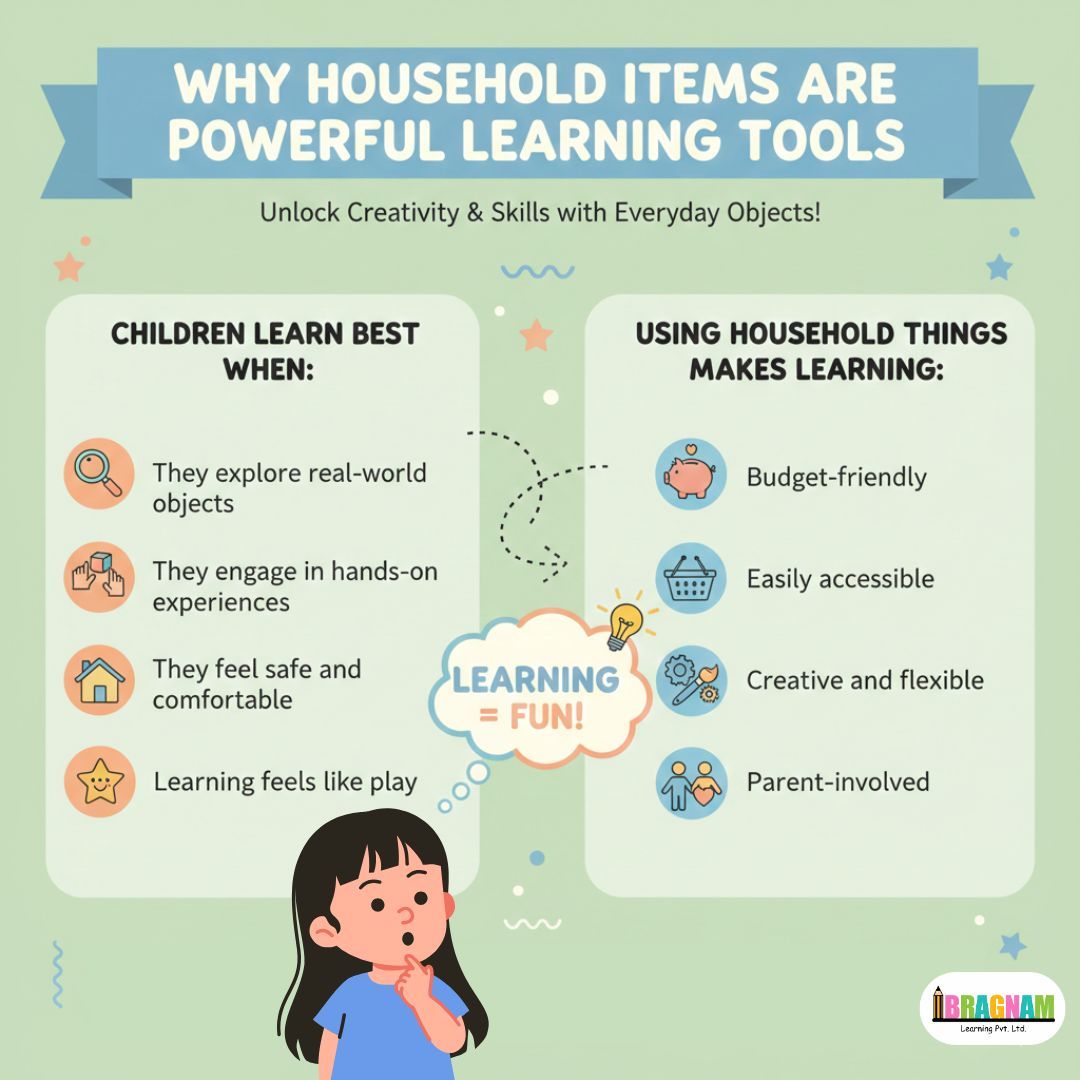
Why Household Items Are Powerful Learning Tools
Before we dive into activities, let’s understand why learning through everyday items works so well.
Children learn best when:
- They explore real-world objects
- They engage in hands-on experiences
- They feel safe and comfortable
- Learning feels like play
Using household things makes learning:
- Budget-friendly
- Easily accessible
- Creative and flexible
- Parent-involved
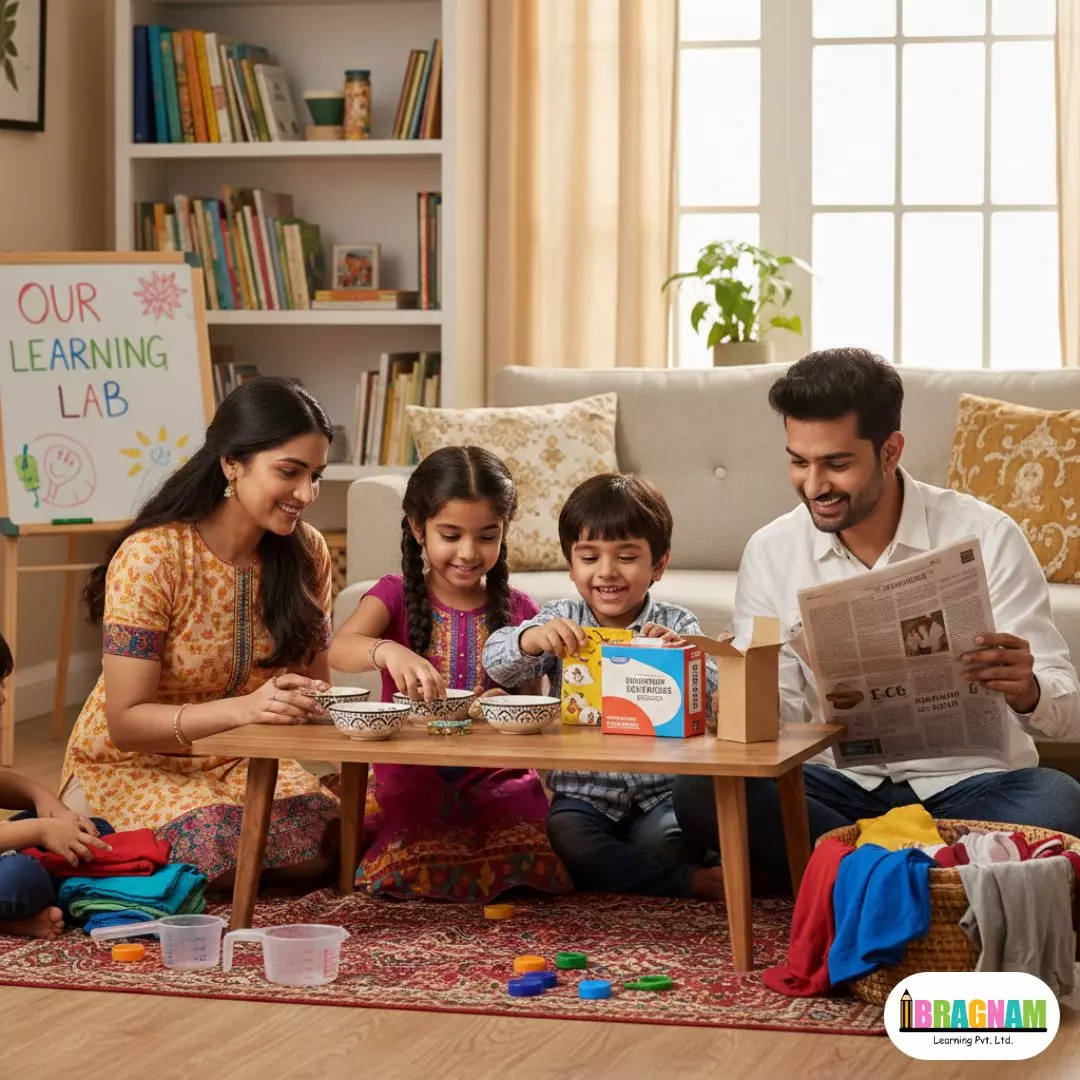
When you understand how to utilise household things for early education, you transform your home into a mini learning lab.
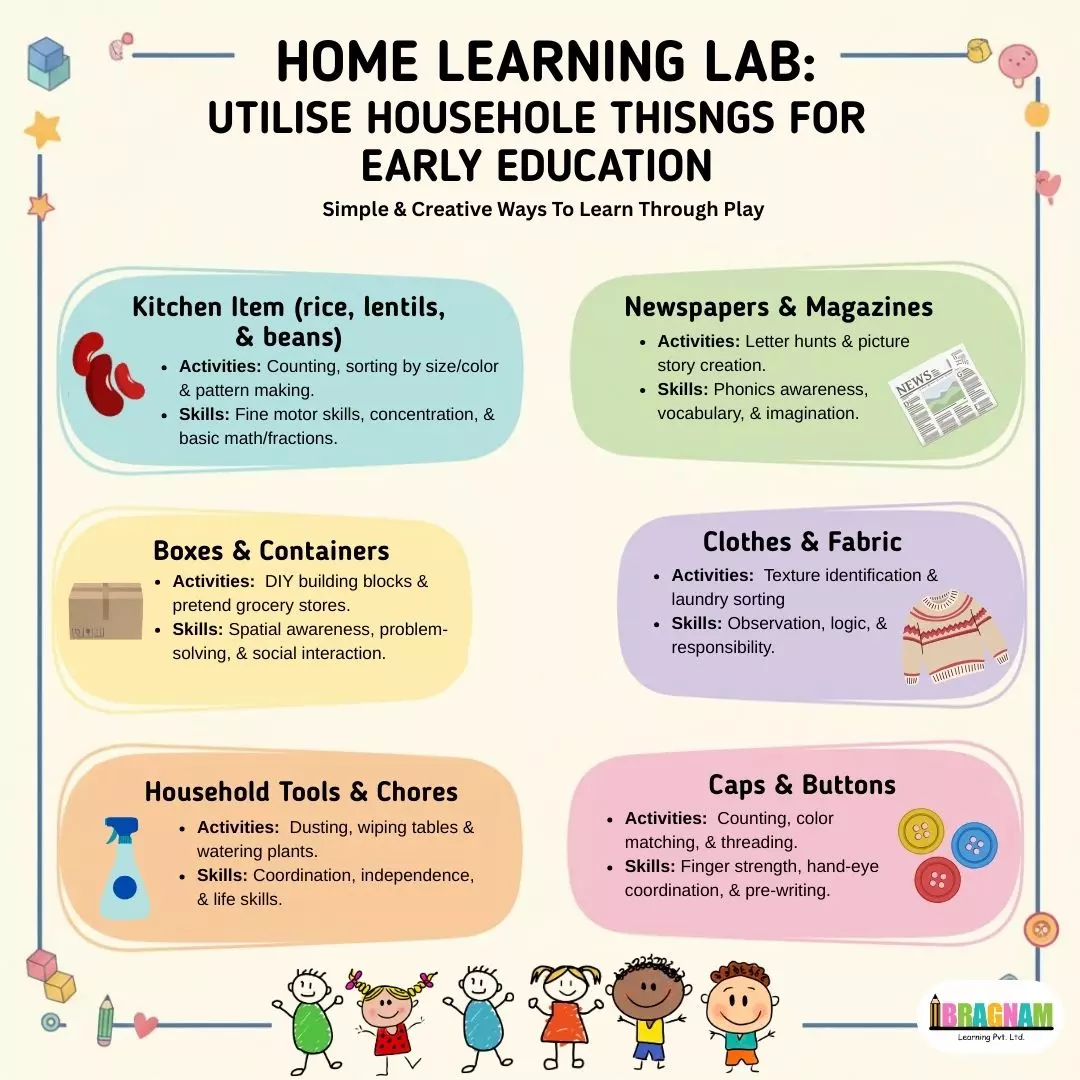
1. Kitchen Items for Learning Activities
The kitchen is a treasure box of learning materials!
🥄 Counting and Sorting with Pulses
Use:
- Rice
- Lentils
- Beans
- Chickpeas
Activity Ideas:
- Counting games
- Sorting by size or color
- Pattern making
- Sensory play
This improves:
- Number recognition
- Fine motor skills
- Concentration
🥣 Measuring Cups for Math Skills
Measuring cups and spoons can introduce:
- Big vs small
- Full vs empty
- More vs less
- Basic fractions
Children naturally learn mathematical concepts when you show them how to utilise household things for early education in everyday tasks like cooking.
2. Newspapers & Magazines for Language Development
Old newspapers are excellent learning tools.
✂️ Letter Hunt Game
Ask your child to:
- Find a specific letter
- Circle all “A” or “B” letters
- Cut out pictures starting with a particular sound
This builds:
- Phonics awareness
- Letter recognition
- Vocabulary
📰 Picture Story Creation
Cut out images and ask your child to create a story.
This enhances:
- Imagination
- Sentence formation
- Creative thinking
Understanding how to utilise household things for early education helps improve literacy skills naturally.
3. Empty Boxes & Containers for Creative Play
Don’t throw away cardboard boxes!
📦 DIY Building Blocks
Use:
- Shoe boxes
- Medicine cartons
- Cereal boxes
Children can:
- Build houses
- Create towers
- Make pretend shops
This develops:
- Spatial awareness
- Problem-solving skills
- Creativity
🛒 Pretend Grocery Store
Use empty food packets and set up a small shop.
Teach:
- Money concepts
- Role play
- Social interaction
Role-play is one of the best examples of how to utilise household things for early education effectively.
4. Clothes & Fabric for Sensory Learning
Old clothes and fabric pieces can be used for:
- Texture identification
- Folding practice
- Color sorting
🧺 Laundry Sorting Game
Ask your child to sort clothes by:
- Color
- Size
- Family member
This builds:
- Observation skills
- Logical thinking
- Responsibility
5. Household Tools for Motor Skill Development
🧹 Cleaning Activities
Give safe tasks like:
- Dusting
- Wiping tables
- Watering plants
These simple activities help children:
- Develop coordination
- Build independence
- Feel responsible
Learning how to utilise household things for early education also teaches life skills.
6. Bottle Caps & Buttons for Fine Motor Skills
Collect bottle caps and large buttons.
Use them for:
- Counting games
- Color matching
- Pattern making
- Threading activities
These improve:
- Finger strength
- Hand-eye coordination
- Pre-writing skills
7. Storytelling with Household Objects
Pick 3 random items from home and ask your child to create a story using them.
For example:
- Spoon
- Teddy
- Shoe
This enhances:
- Communication skills
- Confidence
- Creative expression
This simple exercise shows the power of knowing how to utilise household things for early education creatively.
Tips for Parents
To make the most of household learning:
- Always supervise young children
- Ensure items are safe and non-toxic
- Keep activities short and engaging
- Encourage open-ended play
- Appreciate effort, not perfection
Remember, early education is not about worksheets — it’s about exploration.
Benefits of Using Household Items for Early Education
When you consistently practice how to utilise household things for early education, your child benefits in multiple ways:
- Stronger cognitive development
- Better language skills
- Improved motor coordination
- Increased creativity
- Higher confidence levels
Most importantly, learning becomes joyful and stress-free.
Frequently Asked Questions (FAQs)
1. Why is it important to use household things for early education?
Using household items makes learning practical, affordable, and relatable. Children learn better through real-life experiences.
2. Are household items safe for toddlers?
Yes, but supervision is necessary. Avoid sharp, small, or hazardous objects.
3. Can household learning replace preschool?
Household activities support development, but structured early education programs provide additional social and curriculum-based learning.
4. How often should I do these activities?
Daily short activities (15–30 minutes) are effective and manageable.
5. Do I need special training to teach at home?
No. Simple guidance and involvement are enough. Consistency matters more than expertise.
Suggested Internal Linking Opportunities
- Anchor Text: Importance of Healthy Diet for Kindergarten
Target URL: https://yourwebsite.com/importance-of-healthy-diet-for-kindergarten - Anchor Text: Ramadan activities for playschool
Target URL: https://yourwebsite.com/ramadan-playschool-activities - Anchor Text: Preschool curriculum structure
Target URL: https://yourwebsite.com/preschool-curriculum
Suggested External Links
- Anchor Text: CDC Early Childhood Development Guide
Target URL: https://www.cdc.gov/ncbddd/childdevelopment/index.html - Anchor Text: UNICEF Early Learning Resources
Target URL: https://www.unicef.org/early-childhood-development
Conclusion
Understanding how to utilise household things for early education empowers parents to become active partners in their child’s growth journey. You don’t need expensive materials — creativity, patience, and involvement are enough.
Every spoon, box, newspaper, or bottle cap can become a stepping stone toward your child’s brighter future.
Start today. Look around your home. Pick one simple item — and turn it into a fun learning experience.
Call-to-Action (CTA)
✨ Want more practical early learning ideas for your child?
Stay connected with us for weekly parenting tips, preschool resources, and creative learning activities designed especially for young minds.
👉 Share this blog with other parents and start a home-learning revolution today!


Leave A Comment