
The Role of Play in Cognitive Development
Introduction
Play is more than just fun and games for young children; it is a critical engine driving their cognitive development. At Bragnam Learning, we understand the powerful role that play holds in shaping children’s thinking, problem-solving, attention, creativity, and learning abilities. This blog explores how play nurtures cognitive growth and why it should be an essential part of every playschool’s curriculum.
Why Play Matters for Cognitive Development
Cognitive development refers to the growth of a child’s ability to think, understand, communicate, remember, and solve problems. Play offers the perfect environment for these skills to flourish naturally and joyfully.
Enhances Critical Thinking: Through play, children face challenges that require mental flexibility and decision-making.
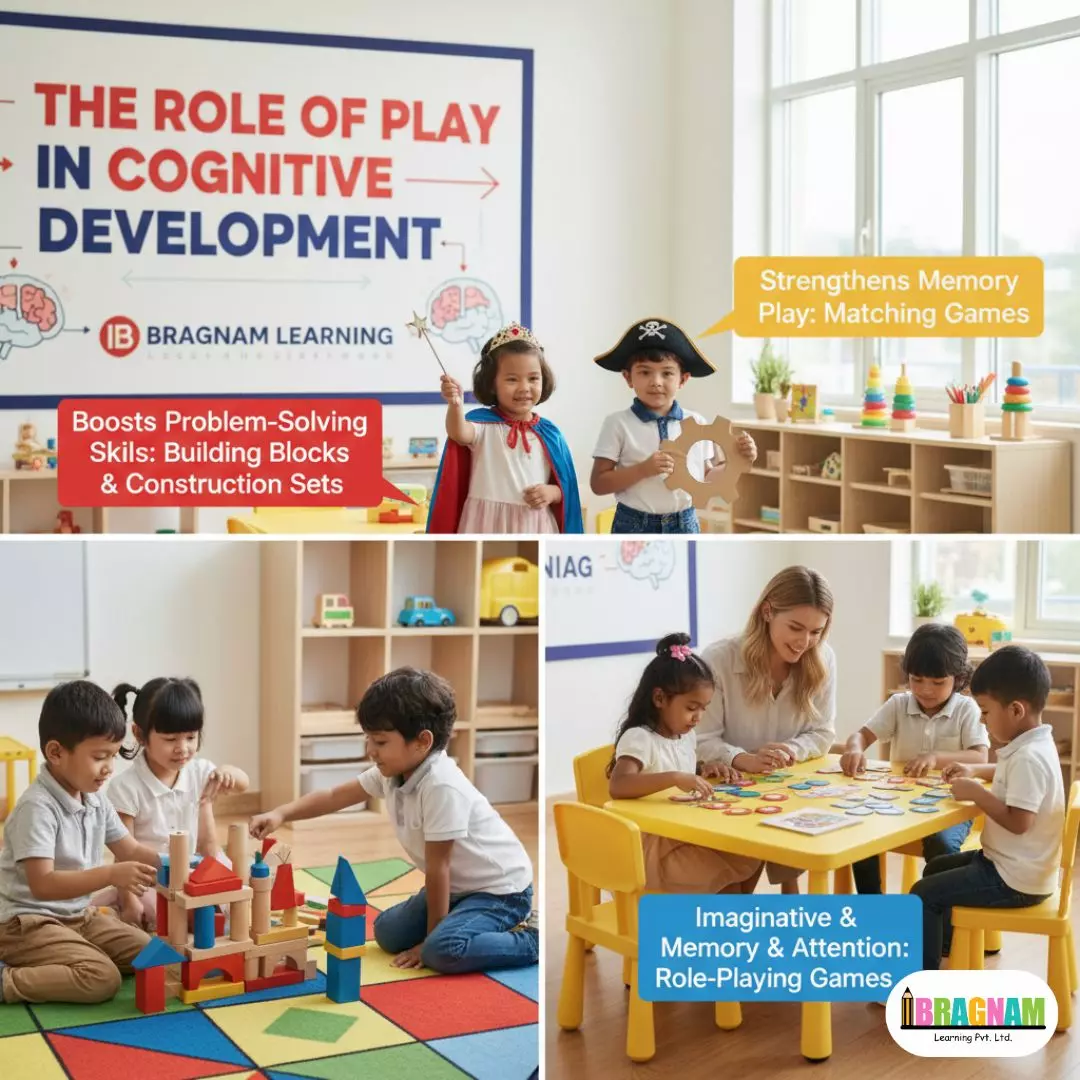
Boosts Problem-Solving Skills: Puzzles, building blocks, and imaginative scenarios teach children to formulate strategies and experiment with solutions.
Fosters Creativity: Imaginative play encourages children to think beyond the obvious and invent new ideas.
Strengthens Memory and Attention: Games that require focus and recall help develop working memory and sustained attention span.
Develops Executive Functions: Activities like role-playing and strategic games help develop planning, organizing, and self-regulation abilities.
How Play Promotes Cognitive Growth
Imaginative and Pretend Play
Pretend play allows children to use their imagination to explore social roles, experiment with different perspectives, and solve complex problems within a safe, flexible framework. This type of play enhances critical thinking and creativity.
Problem-Solving and Exploration
Whether building with blocks or navigating obstacle courses, play encourages active exploration and experimentation. Children learn cause-and-effect relationships and develop spatial awareness, all while having fun.
Social Interaction During Play
Collaborative games and group play foster communication skills, cooperation, and perspective-taking, which are crucial components of cognitive and emotional development.
Physical Play and Brain Development
Outdoor and physical play positively impact brain regions like the hippocampus, improving memory and attention capabilities. Fine and gross motor skills developed through play also support cognitive processes.
Practical Play Activities for Cognitive Development
Here are some play activities that promote cognitive growth:
Building Blocks and Construction Sets: Encourage spatial thinking and problem-solving.
Role-Playing Games: Boost creativity, language, and social understanding.
Memory and Matching Games: Enhance focus and working memory.
Puzzle Solving: Develop reasoning and critical thinking.
Outdoor Exploration: Stimulate curiosity and observational skills.
Conclusion
Play is essential for nurturing cognitive skills in early childhood. It provides children with the freedom to explore, imagine, and solve problems, equipping them with critical thinking and lifelong learning abilities. At Bragnam Learning, we are committed to integrating meaningful play experiences into our playschool curriculum, ensuring every child thrives cognitively while having fun.
FAQ
Q1: How does play improve a child’s brain function?
Play stimulates various brain areas by encouraging problem-solving, creativity, and memory, resulting in stronger neural connections and better cognitive abilities.
Q2: What types of play are best for cognitive development?
Imaginative play, problem-solving games, physical play, and social interactive play all contribute uniquely to developing different cognitive skills.
Q3: How often should children engage in play for optimal cognitive benefits?
Daily playtime, both structured and unstructured, is ideal to support continuous cognitive growth.
Q4: Can digital play support cognitive development?
When used appropriately, educational games and apps can complement traditional play but should not replace physical and social play experiences.
Q5: How can teachers and parents encourage play that supports learning?
By providing diverse, age-appropriate materials, encouraging exploration, and participating in play, adults can create enriching environments that foster cognitive development.




Leave A Comment