Montessori or Regular School? Which is Better
When parents begin searching for the best early education system for their child, one clear question arises—which is better Montessori or regular school? This question is more than just a comparison between two schooling methods; it’s about understanding how each approach impacts your child’s foundational learning, social development, and lifelong attitude toward education.
Choosing between Montessori and a regular school can feel overwhelming. Both have their unique advantages, approaches, and philosophies. To make an informed decision, let’s explore how each system works and what makes one better suited for your child than the other.
Understanding the Montessori Method
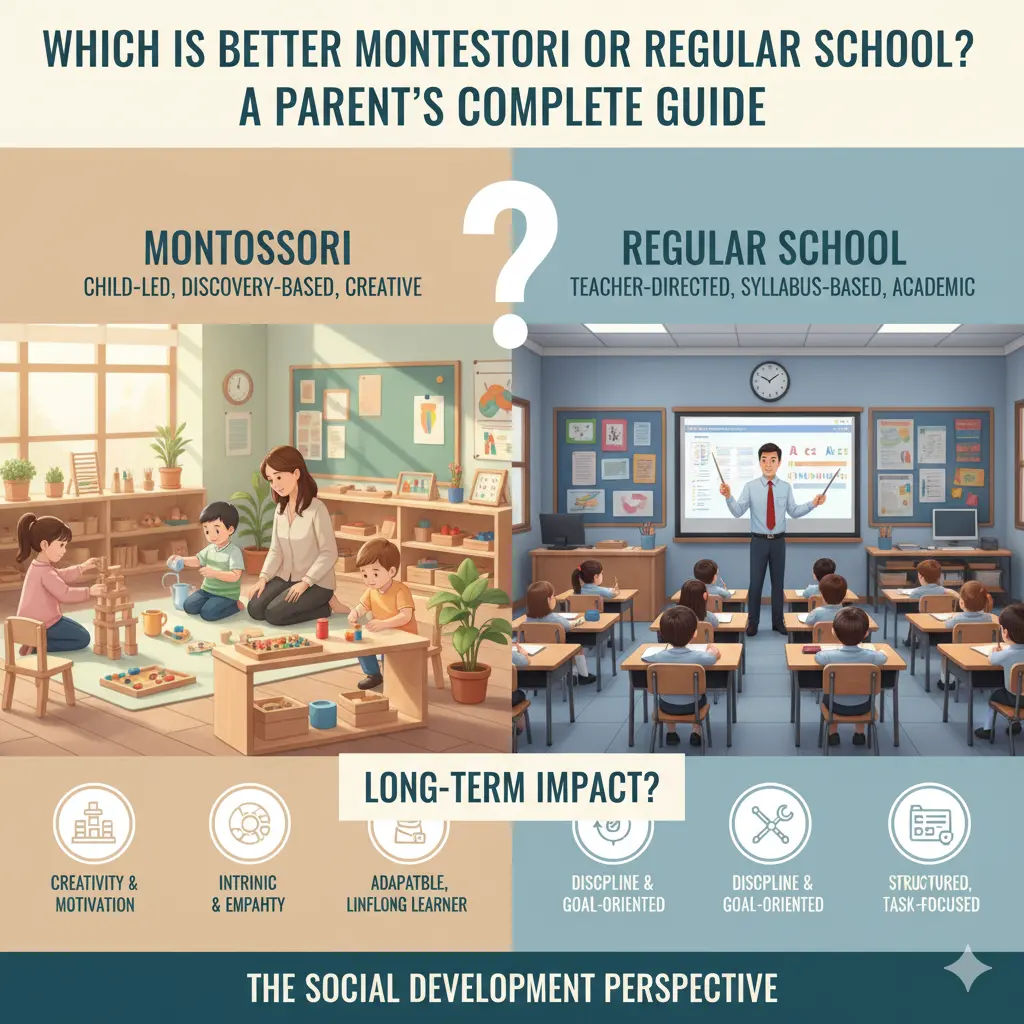
Before you decide which is better Montessori or regular school, it’s important to know what the Montessori system stands for. Established by Dr. Maria Montessori over a century ago, this approach emphasizes child-led learning. In Montessori classrooms, children learn at their own pace through hands-on activities using specially designed materials.
There is minimal traditional instruction or rote memorization. Instead, children explore concepts through real-life experiences, fostering independence and curiosity. Activities are self-corrective—allowing kids to learn from their mistakes without constant adult intervention. Teachers act as guides rather than lecturers, ensuring that every child’s learning style is respected.
Key features of Montessori education:
Child-centric and curiosity-driven learning environment
Mixed-age classrooms to promote peer learning
Hands-on materials that enhance sensory development
Focus on independence and self-discipline
No competitive grading system
This method is scientifically proven to help children develop concentration, coordination, creativity, and confidence—qualities essential for lifelong success.
How a Regular School Works
To fairly answer which is better Montessori or regular school, we must understand the conventional or regular school model. Regular schools follow a structured syllabus where children of the same age learn similar subjects at the same pace. The teacher is the central figure who instructs the class, assigns homework, and evaluates students through tests and grades.
Regular schools are highly standardized, focusing on literacy, numeracy, and discipline from an early age. The emphasis is on academic achievements and social conformity, preparing students for higher education and competitive exams.
Highlights of regular schooling:
Fixed curriculum and uniform teaching methods
Teacher-led instruction
Standardized grading and examinations
Focus on academic knowledge and discipline
Group learning with same-age peers
While regular schools promote consistency and measurable progress, they may sometimes overlook individual learning speeds or creativity.
Comparing Montessori vs Regular School
Now let’s address the core question: which is better Montessori or regular school? The answer often depends on your child’s personality, learning style, and your long-term goals for their development.
| Aspect | Montessori | Regular School |
|---|---|---|
| Learning style | Self-paced, discovery-based | Teacher-directed, syllabus-based |
| Focus | Independence and curiosity | Knowledge and discipline |
| Assessment | Continuous observation | Tests and grades |
| Pace | Individualized | Same for all students |
| Creativity | Encouraged naturally | Sometimes limited by structure |
| Teacher’s role | Guide or facilitator | Instructor |
| Classroom environment | Mixed-age, collaborative | Age-segregated, competitive |
Each system has its merits. Montessori methods foster independence, creativity, and emotional maturity, while regular schools emphasize order, deadlines, and academic rigor—essential traits for later stages of education.
Which System Suits Your Child Best?
Parents often ask which is better Montessori or regular school for their child’s personality and future success. The truth is that the right choice depends on what kind of learner your child is.
If your child is naturally curious, enjoys exploring, and loves learning through real-world experiences, Montessori might be the ideal start. Children who thrive with freedom, creativity, and movement flourish in an environment where they can choose their activities and learn through discovery.
However, if your child prefers structure, guidance, and consistent patterns in learning, a regular school might be more suitable. Traditional schooling builds a strong academic foundation, introduces children to competition, and prepares them for standardized educational pathways.
Parents should also consider long-term compatibility. Montessori preschoolers often transition smoothly into primary education due to their strong sense of responsibility and problem-solving skills, even though the shift to a more structured environment may take some time.
The Social Development Perspective
When deciding which is better Montessori or regular school, social interaction plays a vital role. Montessori promotes multi-age learning, helping younger students learn from older ones and enabling older students to develop leadership skills. This nurtures empathy, cooperation, and mutual respect.
In regular schools, children learn with same-age peers, which fosters direct friendship bonds and age-appropriate competition. They experience teamwork in structured settings such as sports and group projects. Both models contribute to social development, but in distinct ways—Montessori focuses on collaboration, while regular schools build competitiveness and endurance.
The Long-Term Impact
Parents choose early education not just for short-term progress but for lifelong benefits. While analyzing which is better Montessori or regular school, we must look at how learning habits evolve over time.
Montessori-educated children often retain curiosity and intrinsic motivation for learning. They are self-disciplined, creative thinkers who adapt easily to new environments. Regular school students, on the other hand, become skilled at following rules, completing tasks under deadlines, and performing well under structured expectations—all necessary traits for formal academics.
Both systems ultimately aim for the same goal: preparing children to be capable, confident, and compassionate individuals. It’s just that Montessori focuses on developing the process of learning, while regular schools emphasize results and outcomes.
Final Thoughts
As we reach the end of our discussion on which is better Montessori or regular school, it’s evident that there is no one-size-fits-all answer. Both systems offer valuable experiences that shape a child’s growth differently. Montessori nurtures curiosity, independence, and creativity from the ground up, making learning a joyful experience. Regular schools provide a structured, performance-oriented path that prepares children for formal education and the competitive world ahead.
Ultimately, parents should base their choice on their child’s temperament and the values they want to instill early on. Observing your child’s natural preferences and discussing them with teachers can help you make a confident decision.
The real question isn’t simply which is better Montessori or regular school, but which environment will help your child love learning and become the best version of themselves.

Leave A Comment