
- Literacy and Language: Tips on Reading, Storytelling & Language Development for All Our Playschool Franchises
- Introduction
- Why Literacy and Language Development Matters in Playschool
- Tips for Improving Reading Habits in Preschool Children
- Fun Storytelling Activities for Playschool
- How Teachers Can Build Language Skills Daily
- Tips for Parents to Support Language Development at Home
- Benefits of Early Literacy & Language Skills
- Conclusion
Literacy and Language: Tips on Reading, Storytelling & Language Development for All Our Playschool Franchises
Introduction
Early literacy and language development are the foundation of every child’s learning journey. At playschool age, children absorb words, sounds, expressions, and stories faster than at any other stage of life. When teachers introduce reading, storytelling, and conversation habits early, children become confident communicators and curious learners.
This blog has been specially written for all Balvatika Playschool franchises and other early-learning centers to help parents and teachers build strong language development in children. From classroom activities to reading ideas and fun storytelling tricks, you’ll find simple, practical tips that work wonderfully in a preschool environment.
Why Literacy and Language Development Matters in Playschool
Language is not just about speaking—it is about expressing, thinking, understanding, and learning. Early literacy helps children:
Build confidence in communication
Improve vocabulary and pronunciation
Understand stories, events, and instructions
Become prepared for school-level academics
Strengthen imagination, creativity, and memory
Research shows that children who develop early reading and storytelling habits perform better in school and display strong social and emotional skills.
Tips for Improving Reading Habits in Preschool Children
1. Create a Reading-Friendly Environment
Add a colourful reading corner in the classroom
Include picture books, flashcards, storybooks, and alphabet charts
Display letters and words around the room
Children are naturally drawn to books when they are visible, colourful, and fun.
2. Keep Books at Kids’ Eye Level
Little ones cannot ask for what they cannot see. Place bookshelves low and within reach so children can pick and explore their favourite books independently.
3. Begin with Picture and Touch-and-Feel Books
Children love colours and textures. Start with:
Board books
Picture books
Pop-up books
Sensory books
These hold attention longer and build interest in reading.
4. Read Loudly and Slowly
Teachers should read:
With expressions
In different voices
At a slow pace
With pauses
This improves listening skills, word recognition and imagination.
Fun Storytelling Activities for Playschool
Storytelling is one of the best tools for literacy and language development. It helps children learn new words, understand emotions, and improve memory.
1. Puppet Storytelling
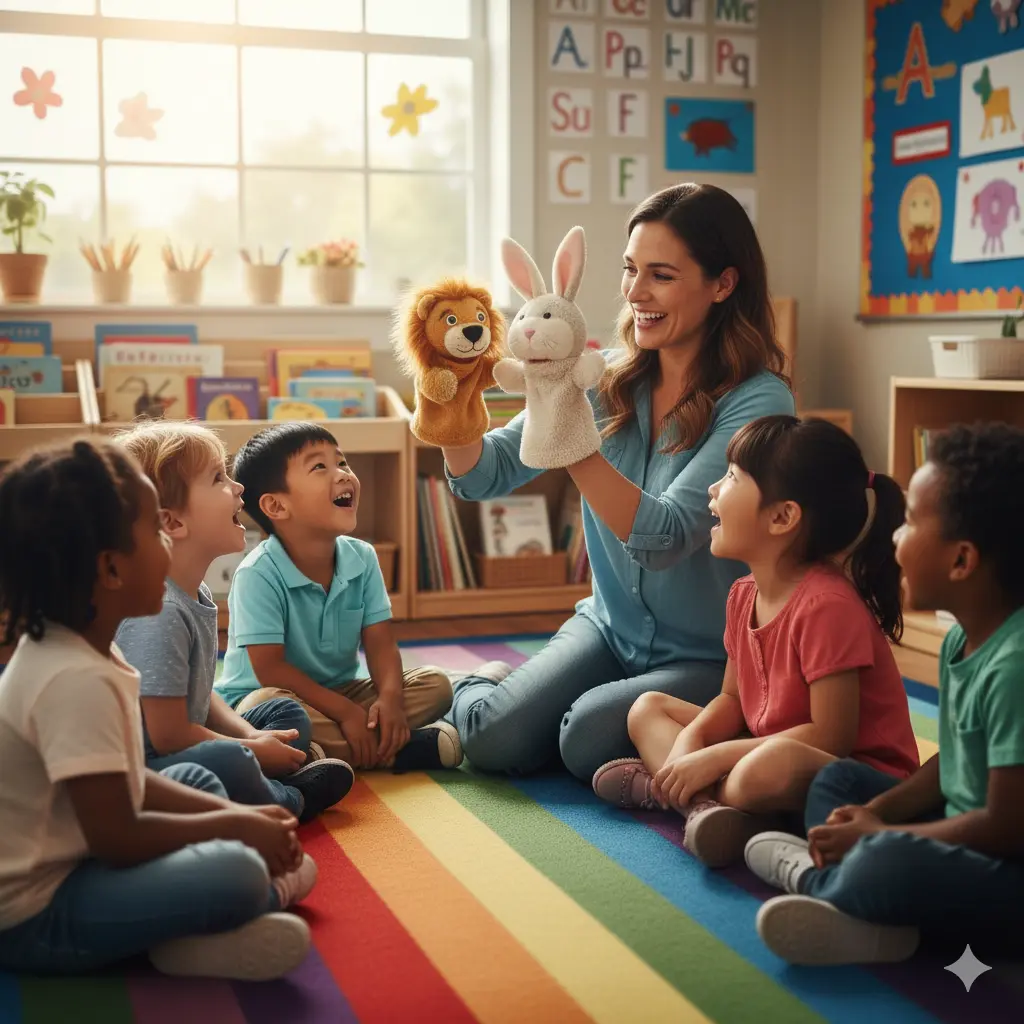
Use hand puppets, finger puppets or soft toys during storytelling. Children remember characters and sounds faster this way.
. Show-and-Tell Activity
A weekly activity where each child brings an object and speaks a sentence about it:
“This is my red car”
“I got this doll on my birthday”
Helps build confidence, vocabulary and sentence formation.
3. Story with drama and action
Let children act like the story characters—
roaring like a lion
hopping like a rabbit
flying like a bird
This builds creativity and keeps them engaged.
4. Story Cards / Story Sequencing
Give children cards with pictures and ask them to place them in order.
This improves memory, logical thinking, and understanding of story flow.
How Teachers Can Build Language Skills Daily
Small daily habits create big learning outcomes. Teachers in all playschool franchises can follow these routine-based methods:
Use conversation during daily tasks
“Please keep the toy on the table”
“Let’s go to the playground”
“Can you count the crayons?”
Ask questions and encourage answers
What is this?
Who is your friend?
What colour is the apple?
Celebrate every small speaking effort
Never laugh at mistakes. Appreciation motivates children to speak more confidently.
Use rhymes and songs
Rhymes improve pronunciation, rhythm and vocabulary.
Daily “Word of the Day”
Teach one new simple word like: big, happy, run, ball, red.
Let children repeat it, draw it and use it in a sentence.
Tips for Parents to Support Language Development at Home
Preschools and parents must work together. Here are simple activities for home:
Read a bedtime story daily
Encourage children to speak full sentences
Reduce mobile screen time
Ask open-ended questions: “What did you do in school today?”
Teach children to greet: Good Morning, Thank You, Welcome
When children hear correct language at home, they learn faster.
Benefits of Early Literacy & Language Skills
Better listening skills
Faster learning in school
Better memory power
Improved social confidence
Strong imagination & creativity
Smooth transition to higher classes
Children who speak confidently also build better friendships and express themselves without fear.
Conclusion
Literacy and language development is not a one-day activity. It grows every day through reading, talking, storytelling, singing and playful conversations. All our playschool franchises should make reading corners, storytelling sessions and interactive language activities a regular part of classroom learning. When children speak confidently, they learn confidently.
Together, let’s build a generation of smart thinkers, happy readers and confident speakers.
FAQs
Q1. What is literacy and language development in playschool?
It refers to building early reading, speaking, listening and communication skills using stories, books, rhymes and conversations.
Q2. How can teachers improve language skills in preschool children?
By encouraging daily conversations, storytelling, rhymes, picture books, word games and open-ended questions.
Q3. Which books are best for toddlers and preschoolers?
Picture books, touch-and-feel books, board books, pop-up books and animal storybooks are best.
Q4. Why is storytelling important in preschool?
Storytelling improves imagination, vocabulary, emotional understanding and memory power.
Q5. How can parents help at home?
Read a bedtime story daily, reduce screens, encourage full sentences, and ask questions about school and day-to-day activities.


Leave A Comment