- Montessori vs. Traditional Education: Compare and Contrast the Two Approaches, Highlighting the Advantages of Montessori
- Introduction
- Understanding Montessori and Traditional Education
- What is Montessori Education?
- What is Traditional Education?
- Key Differences Between Montessori and Traditional Education
- Learning Style and Curriculum
- Role of the Teacher
- Classroom Setup
- Assessment and Feedback
- Advantages of Montessori Education
- Individualized Learning
- Holistic Development
- Active, Engaged Learners
- Strong Social Skills and Empathy
- Lifelong Curiosity and Love for Learning
- Advantages and Limitations of Traditional Education
- Structure and Efficiency
- Preparation for Testing
- Socialization within Limits
- Limited Real-World Relevance
- Montessori in Practice: Real-World Benefits
- FAQ
- Conclusion
Montessori vs. Traditional Education: Compare and Contrast the Two Approaches, Highlighting the Advantages of Montessori
Introduction
Choosing the right educational approach for young children is a pivotal decision for parents and educators. The ongoing debate between Montessori and traditional education often arises when planning a child’s future. Both systems have their strengths and challenges, but Montessori is increasingly gaining favor for its child-centered and adaptive teaching methodologies. This article thoroughly explores both Montessori and traditional education, directly comparing their philosophies, methodologies, classroom environments, and outcomes, while highlighting why Montessori offers unique advantages for today’s learners.
Understanding Montessori and Traditional Education
What is Montessori Education?
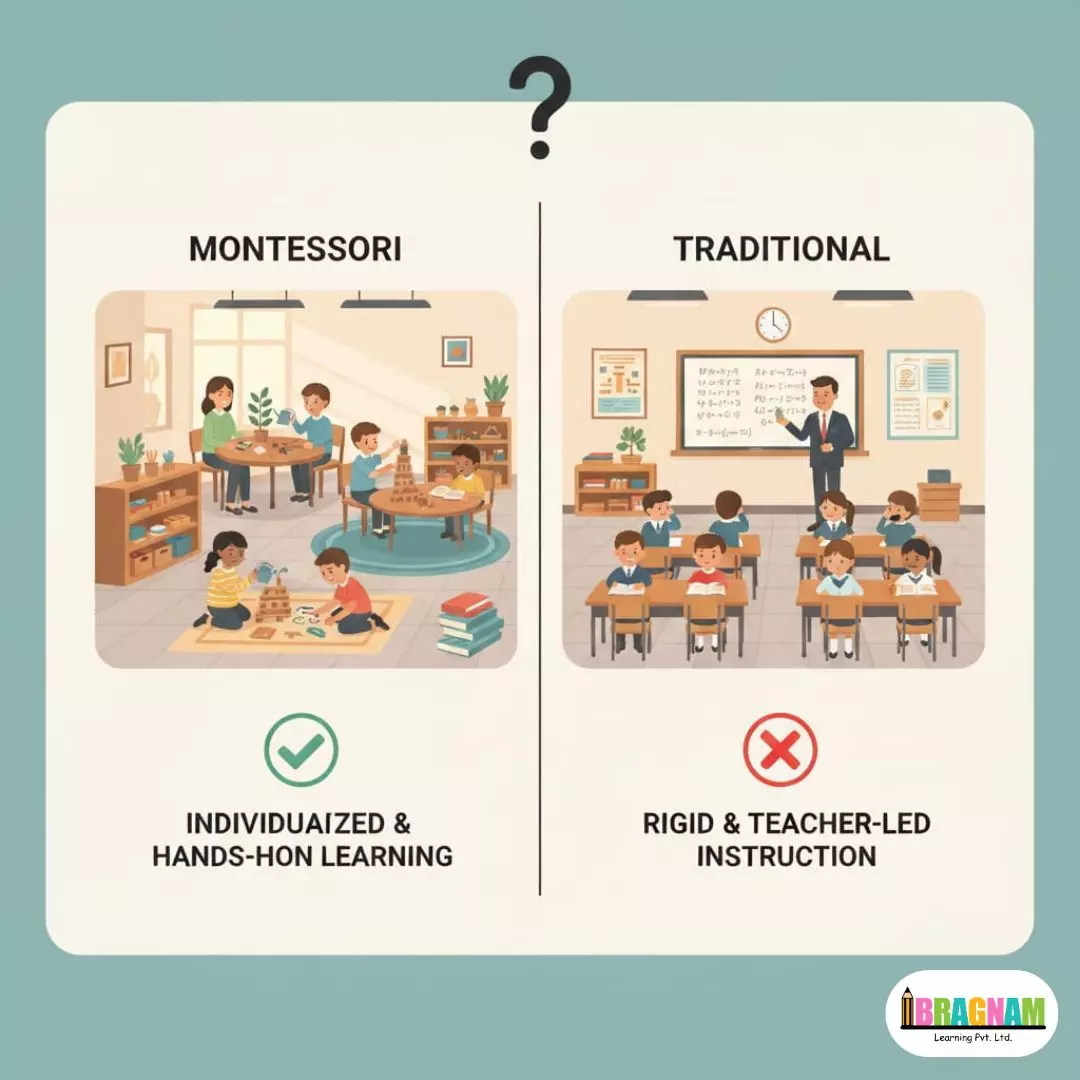
Montessori education, established by Dr. Maria Montessori, centers on fostering natural development, self-paced learning, and child-led discovery. Classrooms are designed as nurturing spaces where children are active participants, encouraged to explore, investigate, and master lessons individually, guided by teachers who act as facilitators rather than direct instructors. Montessori focuses on:
Individualized learning plans suitable for unique developmental stages.
Mixed-age classrooms for holistic social and leadership growth.
Hands-on, sensory-rich activities emphasizing practical life skills and self-directed exploration.
Emotional and social development through collaborative environments.
What is Traditional Education?
Traditional education typically features a fixed curriculum, teacher-led instruction, and uniform lesson delivery. Students progress through predefined schedules, with emphasis on memorization and standardized assessments. Key characteristics include:
One-size-fits-all approach.
Age-specific, single-grade classrooms.
Rote memorization, focus on exams, and theoretical learning.
Competitive environment geared toward grades and external validation.
Key Differences Between Montessori and Traditional Education
Learning Style and Curriculum
Montessori: Learning is self-paced, tailored to individual needs, and driven by the child’s interests. The curriculum adapts as children progress, allowing for deep, enjoyable understanding.
Traditional: Lessons are uniform, taught at the same pace for all. Curriculum is predetermined, with little flexibility for personal needs or interests.
Role of the Teacher
Montessori: Teachers act as guides or facilitators, encouraging autonomy and independence.
Traditional: Teachers are the primary authorities, directing learning and maintaining class discipline.
Classroom Setup
Montessori: Mixed-age groupings foster peer learning, leadership, and empathy. The environment encourages individual and small group work.
Traditional: Children are grouped by age/grade, moving through content collectively, with limited peer interaction across ages.
Assessment and Feedback
Montessori: Focuses on qualitative observations and portfolio-based assessments. Emphasis is on personal progress and self-reflection.
Traditional: Relies on quantitative testing, exams, and grades. Feedback is often standardized and externally motivated.
Advantages of Montessori Education
Individualized Learning
Montessori offers a “follow the child” approach, allowing each child to progress at their own pace, receive personal attention, and explore according to their readiness. This stimulates confidence, creativity, and love for learning.
Holistic Development
The approach addresses cognitive, emotional, social, and physical growth—ensuring learners develop problem-solving abilities, independence, and adaptability for lifelong learning.
Active, Engaged Learners
Students use hands-on materials, learn through discovery, and engage in practical life tasks that build self-esteem and real-world skills—leading to better academic and social outcomes compared to passive learning environments.
Strong Social Skills and Empathy
Montessori’s mixed-age, collaborative setup nurtures empathy, leadership, and community participation, as children interact across ages and support each other’s learning.
Lifelong Curiosity and Love for Learning
Self-paced, interest-driven activities cultivate curiosity, resilience, and intrinsic motivation, preparing children for future academic and real-world challenges.
Advantages and Limitations of Traditional Education
Structure and Efficiency
Traditional systems are structured and efficient for information transmission, offering predictable routines and assessment schedules. However, they may struggle to accommodate diverse learning needs, often leading to disengagement for non-standard learners.
Preparation for Testing
The emphasis on exams can enhance focus on theoretical standards, but may stifle creativity and real-world application of knowledge.
Socialization within Limits
While single-grade classrooms facilitate age-equivalent socialization, they may limit leadership growth and peer mentorship opportunities seen in Montessori.
Limited Real-World Relevance
Traditional settings often prioritize memorization over exploration, making students less prepared for practical life and adaptive problem solving.
| Features | Montessori Education | Traditional Education |
|---|---|---|
| Learning Approach | Child-centered, individualized, hands-on | Teacher-led, one-size-fits-all, theoretical |
| Curriculum Flexibility | Adapts to child’s interests and pace | Fixed and predetermined |
| Teacher’s Role | Facilitator and guide | Authority and instructor |
| Assessment | Observational, portfolio-based | Exams, grades, standardized testing |
| Social Environment | Mixed-age, peer learning, collaboration | Age-specific, competitive, limited peer interaction |
| Focus of Development | Holistic (cognitive, social, emotional, physical) | Academic-heavy, less on social-emotional skills |
| Adaptability | Highly adaptable, embraces diversity | Less adaptable, structured learning path |
| Motivation | Intrinsic, discovery, curiosity-driven | Extrinsic, grades and validation-driven |
Montessori in Practice: Real-World Benefits
Enhanced independence, confidence, and adaptability for academic and life situations.
Stronger social and emotional skills backed by research on classroom outcomes.
Integration of academics with purposeful, meaningful work beyond rote memorization.
Support for lifelong learning habits recognized internationally.
FAQ
Q1: What makes Montessori education different from traditional methods?
Montessori uses child-led, individualized learning approaches, while traditional systems rely on teacher-led, uniform lesson delivery and standardized assessments.
Q2: Are Montessori students better prepared for real-world challenges?
Yes, Montessori fosters critical thinking, adaptability, and problem-solving through practical life skills and self-directed exploration.
Q3: Can Montessori education help children struggling in traditional settings?
Montessori’s adaptable curriculum and personalized attention often benefit students who find rigid systems challenging.
Q4: Which approach supports better social skills development?
Montessori’s mixed-age, collaborative environment enhances empathy, leadership, and community feeling, while traditional systems may promote competition.
Q5: Is Montessori a good fit for all children?
Most children benefit from Montessori’s holistic and flexible approach, but some may prefer structure and familiarity provided by traditional methods.
Conclusion
Montessori and traditional education each offer distinct frameworks for nurturing children. While traditional schooling provides routine and structure, its inflexibility can hinder engagement and holistic growth for some learners. Montessori, in contrast, excels in nurturing curiosity, independence, and social-emotional skills through adaptive, child-centered practices. As lifelong learning and real-world readiness become essential, Montessori stands out as a forward-thinking choice for early childhood education. Consider the unique needs and personality of your child when making education decisions, and explore opportunities to integrate Montessori principles for a brighter future.


Leave A Comment